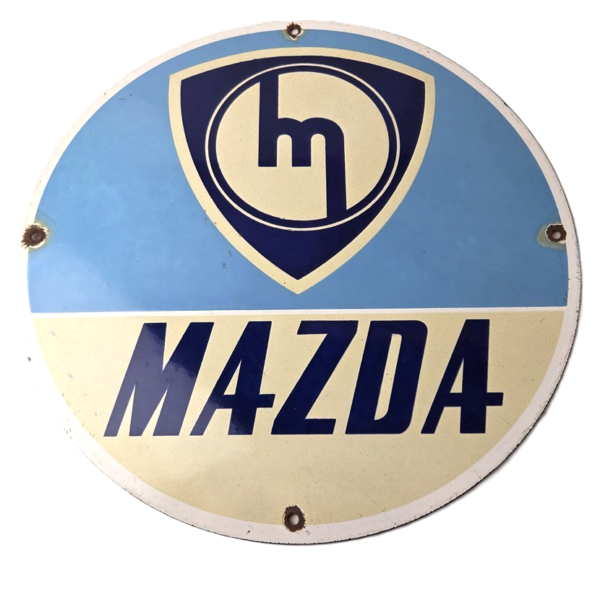
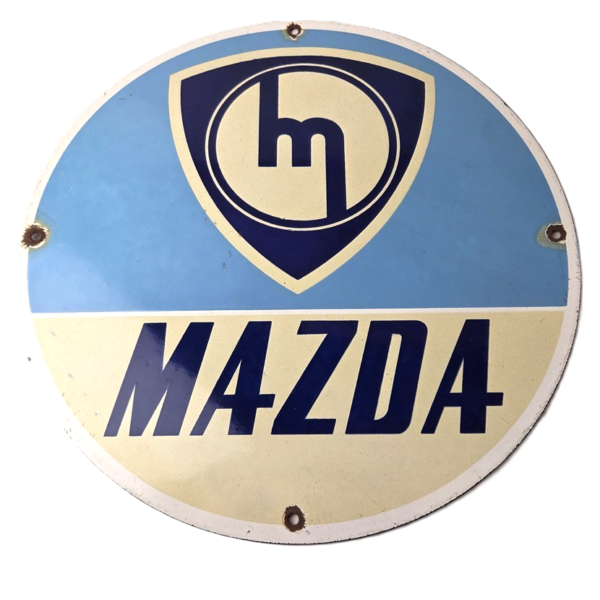
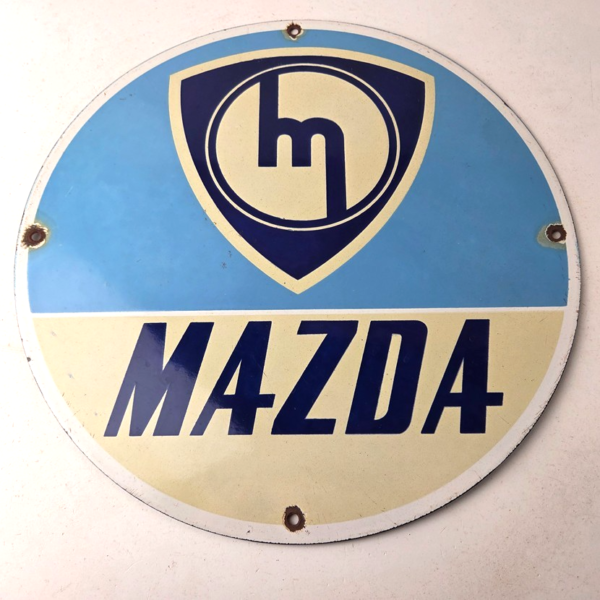





Vintage Mazda Porcelain Sign | Automobile Repair Shop Gas Pump
$142.47
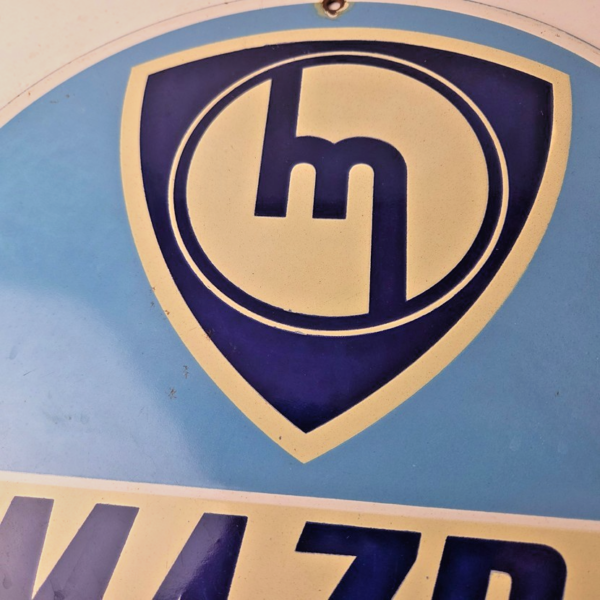
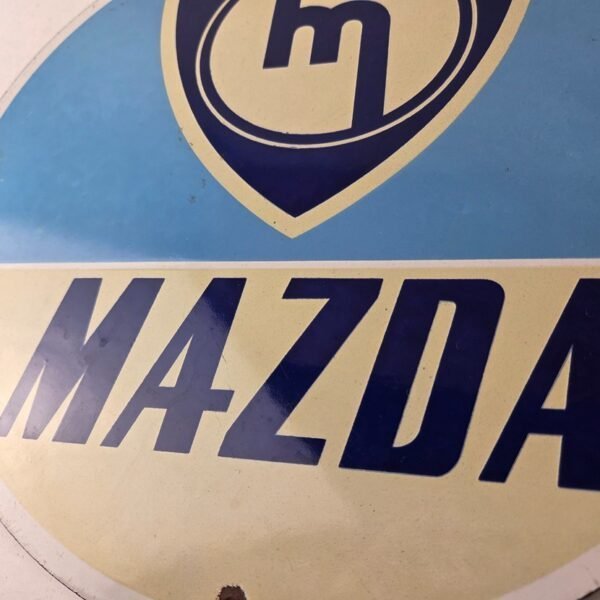
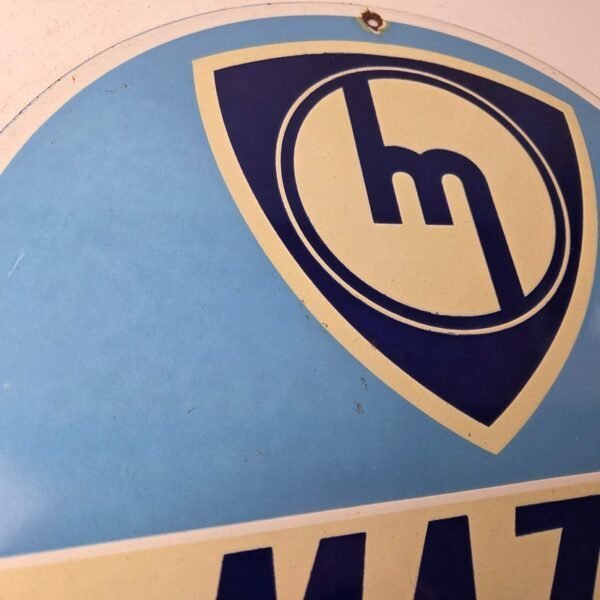
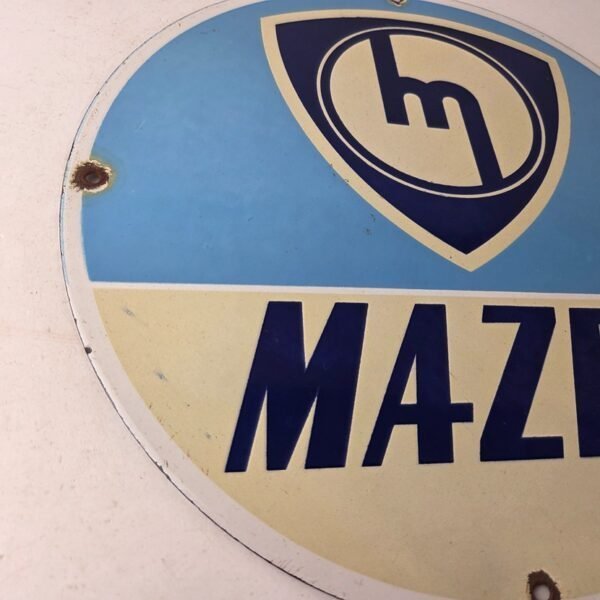
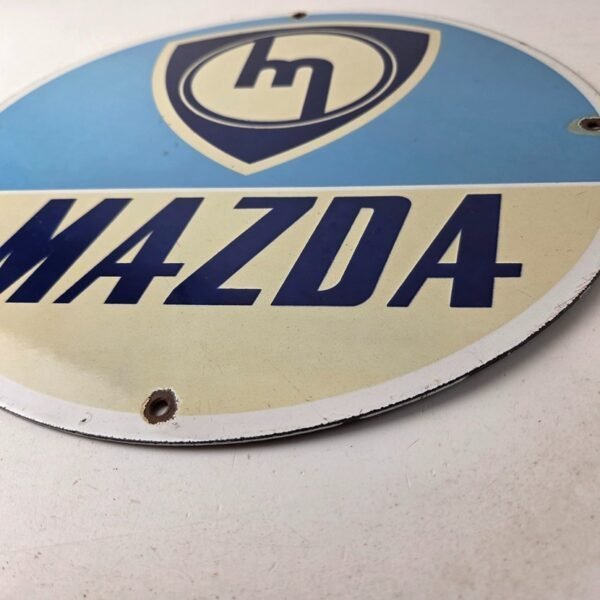
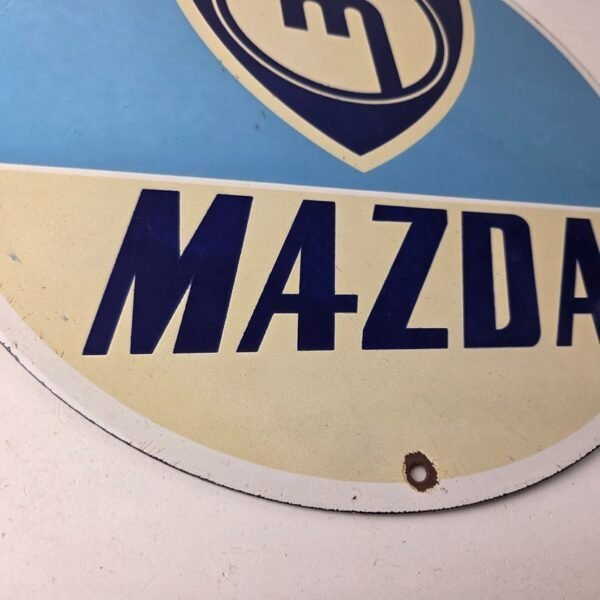
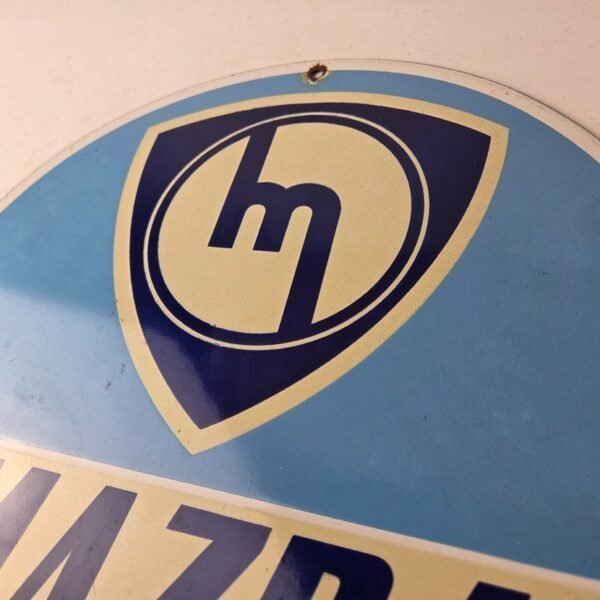
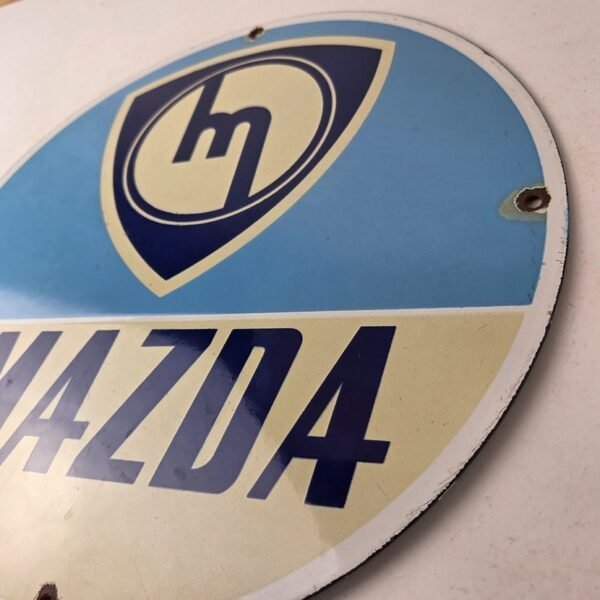
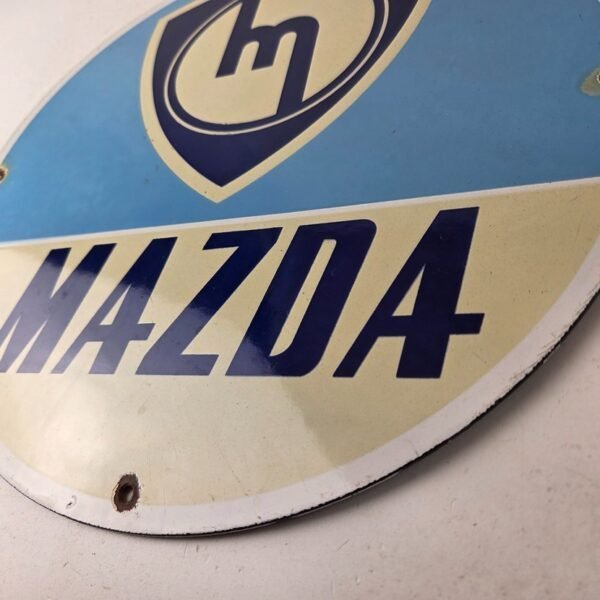
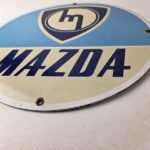
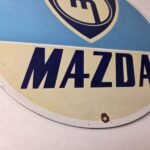
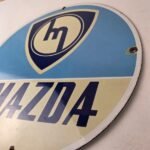
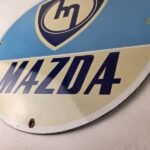
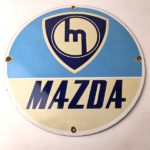
A vintage Mazda automobiles porcelain enamel sign in the authorized dealer repair shop and gas pump display format — one of the most sought-after pieces in the Japanese automobile and automotive service station sign collecting market. Produced under the Toyo Kogyo Co., Ltd. corporate era, when Mazda was still the brand name used on all vehicles despite the company not formally adopting the Mazda Motor Corporation name until 1984. The Mazda brand itself traces to 1931, when Jujiro Matsuda named the company’s first vehicle — the three-wheeled Mazda-Go — after Ahura Mazda, the ancient Zoroastrian god of wisdom and harmony. Original kiln-fired vitreous enamel on heavy-gauge steel. Unrestored. Authenticated. Ships fully insured.
Vintage Mazda Porcelain Sign — Authorized Automobiles Repair Shop and Gas Pump Display, Authentic Kiln-Fired Enamel Piece
This is an authentic vintage Mazda automobiles porcelain enamel sign in the authorized dealer repair shop and gas pump display format — a genuine kiln-fired advertising piece produced for display at Mazda franchise repair workshops and fuel service points during the brand’s formative years in the American and international automobile markets. It is original — kiln-fired vitreous glass enamel on heavy-gauge steel — not a reproduction, a licensed reprint, or a modern tin-plate copy.
Mazda automobile dealer and repair shop signs occupy a specific and growing niche within the petroliana and automobilia collecting categories — rare enough to command premiums over common domestic brands, recognisable enough to attract both specialist Mazda collectors and mainstream vintage sign buyers.
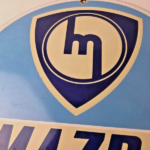
Every colour on this sign is kiln-fired glass, not ink or paint. Fused to the steel substrate at temperatures between 750 and 900 degrees Fahrenheit, the multi-layer enamel surface is why a piece produced 50–60 years ago retains vivid, deep colour where a printed sign from the same era would be long faded or rusted through.
From Cork to Cars: The Mazda Brand Story, 1920–1984
Mazda’s corporate origin is one of the more unusual in automotive history. The company that would become Mazda Motor Corporation began on 30 January 1920 in Hiroshima, Japan, as Toyo Cork Kogyo Co., Ltd. — a cork manufacturing company. Its president, Jujiro Matsuda (1875–1952), had come to cork manufacturing late in a career already marked by engineering achievement. Matsuda had apprenticed as a blacksmith in Osaka as a young man, then founded his own company — Osaka Matsuda Manufacturing — developing patented water pump designs before returning to his native Hiroshima. When Toyo Cork Kogyo ran into financial difficulty, Matsuda was brought in to lead it. A factory fire in 1925 destroyed 70 percent of the facility. Matsuda responded by pivoting the company away from cork entirely, changing its name to Toyo Kogyo Co., Ltd. in 1927 and redirecting it toward machine tool manufacturing.
In 1929, Toyo Kogyo built its own motorcycle from scratch — a 250cc two-stroke machine — and debuted it at a race in Hiroshima, where it defeated the British Ariel, the odds-on favourite. This racing debut put the company on a different trajectory. Two years later, in 1931, Toyo Kogyo launched the Mazda-Go — a three-wheeled auto rickshaw that became one of the most successful vehicles in the Japanese light commercial market, and the piece of hardware on which the Mazda name was first used commercially. The name was chosen from two sources: Ahura Mazda, the supreme deity of Zoroastrianism — the ancient Persian religion founded by the prophet Zoroaster, whose god was revered as the embodiment of wisdom, harmony, and light — and the founder’s own surname, Matsuda, which phonetically yields ‘Mazda’ in Japanese romanisation. Key members of Toyo Kogyo interpreted the name as a symbol connecting East and West, and the beginning of a new automotive civilisation.
The Ahura Mazda connection gives this brand an etymological depth that almost no other automotive marque can claim. The Zoroastrian deity was worshipped across a civilisation stretching from ancient Persia to Central Asia for over 3,500 years before the Mazda-Go was ever built. Owning a Mazda sign means owning a piece of a brand whose very name encodes one of humanity’s oldest religious traditions.
Hiroshima, World War II, and Rebuilding
The backdrop to Mazda’s early commercial history is inseparable from the history of Hiroshima itself. Toyo Kogyo produced weapons for the Japanese military throughout World War II — most notably the Type 99 rifle series. The atomic bombing of Hiroshima on 6 August 1945 killed approximately 80,000 people instantly and devastated the city. Toyo Kogyo’s main plant in Fuchu, a few miles outside the city centre, survived the blast largely intact. The company immediately made its facilities available to the Hiroshima prefectural government — which had lost all its buildings — and began working to restart production within four months of the war’s end.
By providing affordable three-wheeled trucks to Hiroshima residents and businesses during the reconstruction period, Toyo Kogyo — under Jujiro Matsuda’s philosophy of ‘giving back to society through engineering’ — played a direct role in the city’s economic recovery. Vehicle production exceeded 3,000 units per month by 1953. The company launched its first passenger car, the Mazda R360 Coupe, in 1960 — and for three consecutive years thereafter, Toyo Kogyo was Japan’s leading producer of automobiles.
Collector context: Mazda signs from the Toyo Kogyo era (pre-1984) carry a historical significance that goes beyond automotive collecting — they are artefacts from a company that was part of the physical reconstruction of one of the 20th century’s most historically consequential cities.
The Rotary Revolution and the American Market: 1961–1973
In July 1961, Toyo Kogyo signed a licence agreement with the German companies NSU Motorenwerke AG and Wankel GmbH to develop the Wankel rotary engine — a revolutionary internal combustion engine concept using a triangular rotor inside an oval housing in place of conventional pistons. While NSU and several other manufacturers including General Motors, Daimler-Benz, and Citroën investigated the technology, all eventually abandoned it. Mazda did not.
Chief Engineer Kenichi Yamamoto assembled a team of 47 engineers — later known as the ’47 Samurai’ within Mazda — to solve the rotary’s critical flaw: the apex seals at the tips of the triangular rotor would judder against the housing wall, leaving characteristic scratches nicknamed ‘devil’s claw marks’ that caused engine seizure. After years of development, they solved it with carbon apex seals and precision housing geometry. On 30 May 1967, Mazda unveiled the Cosmo Sport 110S — the world’s first production car powered by a twin-rotor Wankel engine. Only 1,176 were hand-built, at approximately one per day. Yamamoto later became president and chairman of Mazda.
Vehicle exports to the US began when 60 R100 coupes departed Hiroshima on 14 April 1970, arriving at the port of Seattle. The first Mazda dealerships opened in Oregon and Washington, with regional offices following in Seattle, Florida, and Texas. By the early 1970s, around 100,000 rotary-engined Mazdas per year were being sold in the US alone, making Mazda one of the most rapidly growing import brands in the American market. The rotary’s smooth, free-revving character and strong power-to-weight ratio made it genuinely competitive against domestic V8-powered muscle cars.
The timing of this sign: a Mazda repair shop and gas pump sign produced in the late 1960s or early 1970s would have been part of the first wave of Mazda franchise infrastructure in the American market — a network being built from scratch, geographically starting on the Pacific Coast and expanding east. These signs are artefacts from the very beginning of Mazda’s US commercial presence.
The Authorized Repair Shop Sign and Gas Pump Plate Format
This sign combines two distinct commercial advertising functions: the authorized dealer repair shop designation — identifying a licensed Mazda service facility — and the gas pump plate format, the standard rectangular porcelain display panel used at fuel dispensers and automotive service points throughout the 1950s, 1960s, and into the 1970s. The combination was common practice for import automobile brands entering the US market, where authorized repair and parts availability was a critical selling point — potential buyers of an unfamiliar foreign marque needed reassurance that service infrastructure existed.
For Mazda specifically, the rotary engine created an additional service credential requirement. The Wankel engine was genuinely unlike anything domestic mechanics had trained on — a different combustion architecture, different maintenance intervals, and different service procedures. An ‘authorized Mazda repair’ sign did not just mean ‘we fix cars’: in the early 1970s, it meant the shop had trained specifically on rotary engine service, a significant technical distinction.
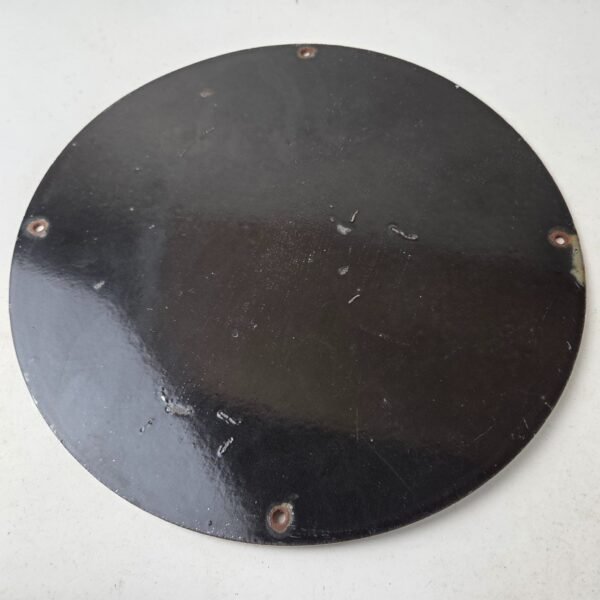
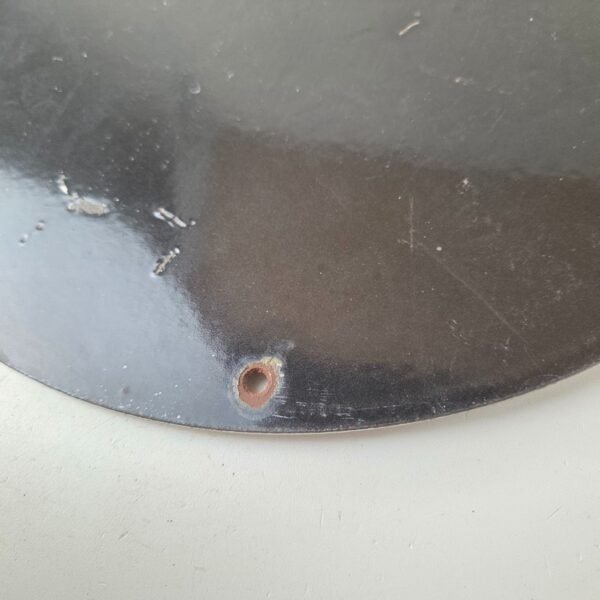
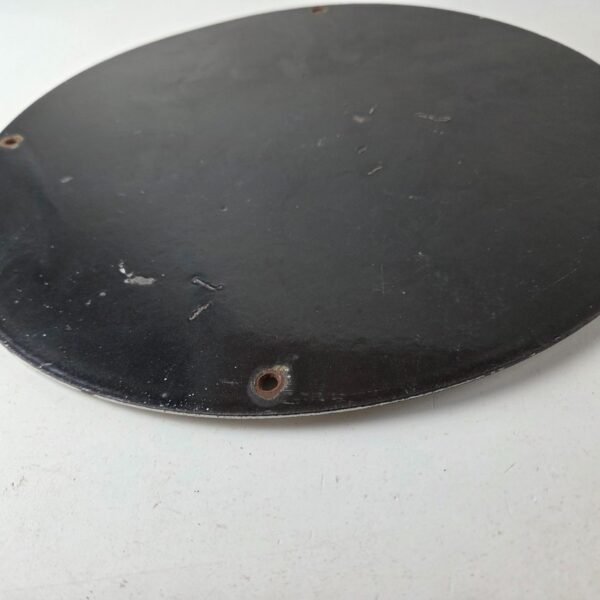
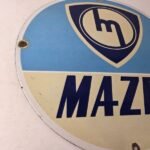
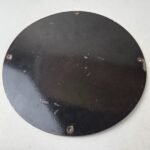
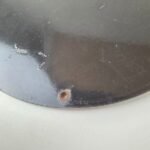
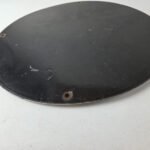
Condition note: This sign is presented in original, unrestored condition. Any surface wear or minor chipping reflects natural aging from active commercial display use over 50–60 years. Original unrestored condition is the preferred standard for serious automobilia and petroliana collectors — a mechanically honest piece commands more collector respect than a cosmetically touched-up restoration.
Product Specifications
| Specification | Detail |
| Product type | Vintage porcelain enamel sign (original, not a reproduction) |
| Brand | Mazda Automobiles |
| Corporate name | Toyo Kogyo Co., Ltd. (founded 30 January 1920, Hiroshima, Japan) |
| Mazda name origin | 1931 Mazda-Go auto rickshaw — named for Ahura Mazda, Zoroastrian god of wisdom |
| Mazda Motor Corp | Company formally renamed Mazda Motor Corporation in 1984; Mazda name used on all vehicles from 1931 |
| Sign function | Authorized automobile dealer / repair shop designation and gas pump display |
| Sign format | Gas pump plate — rectangular advertising panel for service point display |
| Era / Date | Circa 1960s–1970s — early US market era; Toyo Kogyo Co. corporate period |
| Construction | Kiln-fired vitreous enamel on heavy-gauge steel, 18–22 gauge |
| Surface | Multi-layer glass enamel, fired at 750–900 degrees Fahrenheit |
| Collector category | Automobilia · Petroliana · Vintage advertising signs · Japanese import cars |
| Condition | Original, unrestored — see condition note above |
| Authentication | Authenticated by Vintage Porcelain Signs Store |
| Shipping | Professionally packed, fully insured for sold value |
Why This Sign Is Collected: Three Overlapping Collector Categories
The vintage Mazda automobiles porcelain sign sits at the intersection of three collecting markets, each with distinct buyer vocabulary and search behaviour:
1. Automobilia and Japanese Import Car Collectors
Mazda is one of the most collected Japanese automotive marques in the American and international automobilia market. The brand’s engineering distinctiveness — the Wankel rotary engine, which every other major automaker attempted and abandoned — gives Mazda a collector identity that transcends the generic ‘vintage Japanese car’ category. Mazda collectors specifically seek pre-1984 Toyo Kogyo era pieces, including the early US market dealership and service infrastructure signs that represent the first wave of the brand’s American commercial presence.
2. Petroliana and Service Station Collectors
The gas pump plate format places this sign squarely in the petroliana collecting category — one of the most active and well-organised segments of the vintage sign market. Petroliana collectors who focus on automotive service point signage actively seek manufacturer-specific service and repair shop signs, particularly from import brands that had small US dealer networks in their early years. Scarcer brand-specific service signs command premiums over common petroleum company signs precisely because of their lower surviving population.
3. Vintage Automotive Advertising Sign Collectors
As a kiln-fired porcelain enamel sign for an automobile manufacturer — rather than a fuel or oil brand — this piece occupies a specific sub-category within the broader vintage automobile sign collecting market. Pre-1980s automobile manufacturer porcelain signs are increasingly scarce: the shift away from enamel signage to cheaper printed and plastic formats during the late 1960s and 1970s means that surviving original porcelain examples from this era represent a finite and non-replenishable population.
Additional Buyer Audiences
- Man cave and garage display buyers:Mazda’s brand identity — Japanese engineering precision, rotary engine innovation, motorsport heritage — resonates strongly with the enthusiast car culture that drives the man cave and garage décor market. A vintage porcelain Mazda sign is both an authentic artefact and a strong statement of automotive taste.
- Mazda RX-7, RX-3, and rotary engine enthusiasts:The rotary engine community is one of the most enthusiastic and brand-loyal segments of the Japanese car scene. Vintage Mazda signage from the rotary era is a natural complement to RX-7, RX-3, and R100 restoration projects and display spaces.
- Japanese automotive history collectors:The Toyo Kogyo era of Mazda history — the Hiroshima factory that survived the atomic bomb and helped rebuild the city, the 47 Samurai engineers who solved the rotary engine’s apex seal problem, the 1970 US market entry with 60 R100 coupes — is rich and documented enough to attract collectors interested in mid-20th-century Japanese industrial history as much as automotive collecting.
Market context: Authentic porcelain signs for Japanese automobile brands from the 1960s and 1970s are among the faster-appreciating categories in the automobilia and petroliana collecting market. The combination of brand recognition (Mazda remains a globally known active automaker), format rarity (kiln-fired enamel production ended in this era), and the brand’s unique rotary engine engineering story gives pieces like this strong long-term collector demand.
Authenticity, Display & Related Collections
Authentication
This sign passes all standard porcelain enamel authentication checks — weight (heavy-gauge steel substrate), continuous edge enamel wrap, mounting hole wear consistent with decades of commercial display, and the deep glassy sheen of genuine kiln-fired enamel surface rather than a printed or screen-applied reproduction. For a full authentication methodology see our Porcelain Sign Authentication Guide. For automobilia and petroliana collecting guidance, our Collector Resources page provides links to key reference sources.
Where This Sign Displays Best
- Garages, workshops, and man caves:The authorized repair shop designation and gas pump plate format make this a natural fit for automotive-themed display spaces. It pairs well alongside petroliana, oil company signs, and other automobile manufacturer pieces.
- Mazda or rotary engine themed collections:A centrepiece for an RX-7, RX-3, or R100 display space — or the anchor of a broader Mazda Motors of America early-era collection.
- Automotive service business décor:Original dealership and repair shop porcelain signs are used as authentic historical décor in automotive workshops, classic car restoration shops, and vintage vehicle dealerships.
- Japanese automobile and petroliana collections:A strong crossover piece that works in both the automobilia and petroliana collecting contexts, and that brings a Japanese marque identity into typically domestic-brand-dominated service station sign displays.
Explore Related Collections
More vintage automobile signs · Gas & motor oil signs · Motor oil signs · Aviation signs · Authentication Guide · Collector Resources · Full shop