
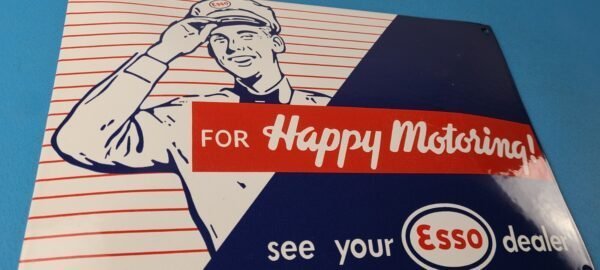
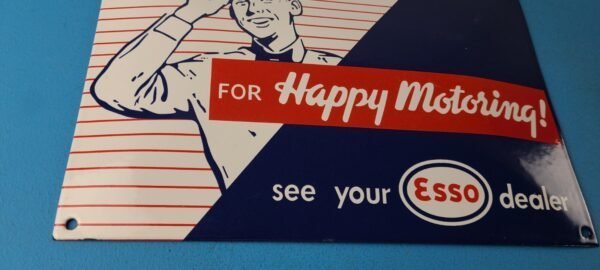
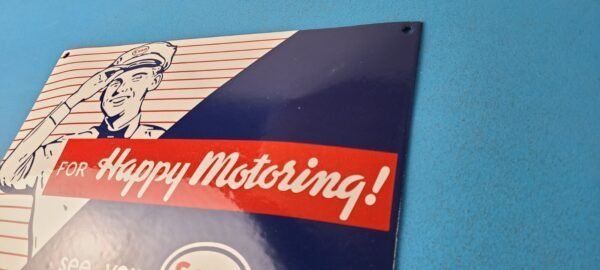
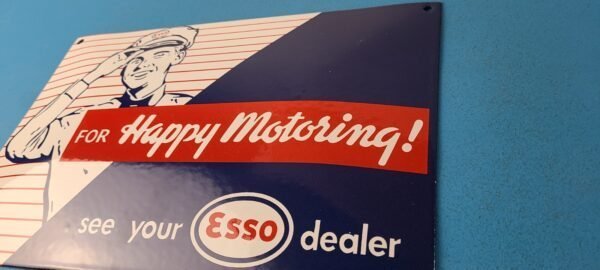
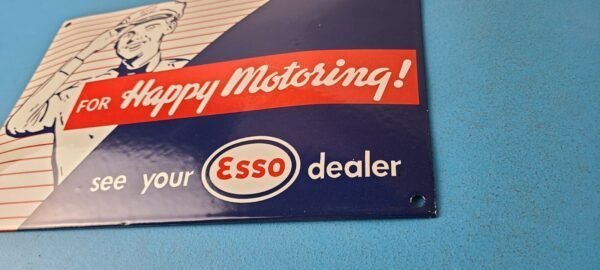
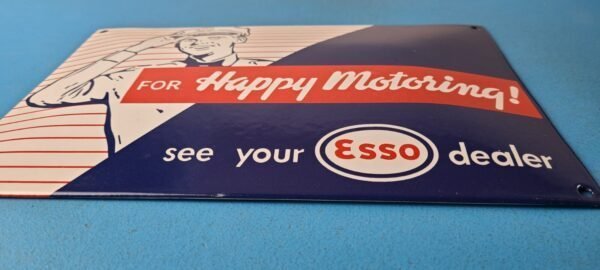
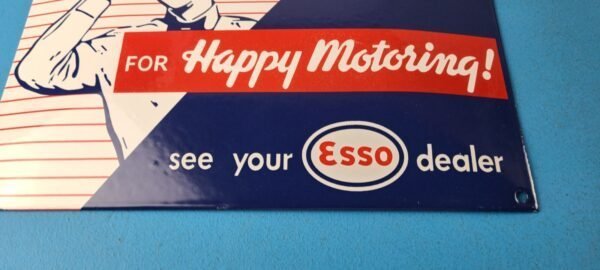
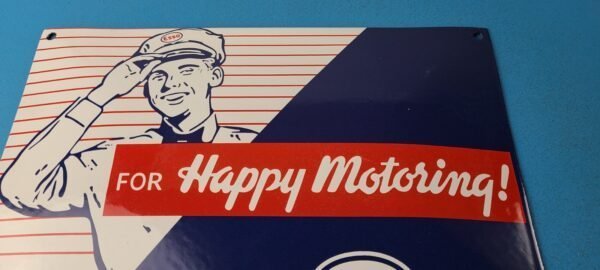



Vintage Esso Gasoline Sign – Porcelain Gas Attendant Filling Station Pump Sign
$130.37
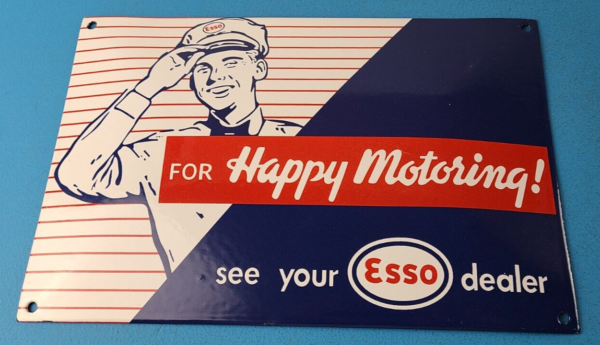
A vintage Esso porcelain enamel sign in the filling station gas attendant and pump display format — an authentic kiln-fired advertising piece from the golden age of the full-service American service station. Esso is the phonetic pronunciation of ‘S.O.’ — the initials of Standard Oil — and was formally launched as a brand by Standard Oil of New Jersey (Jersey Standard) in 1926, following John D. Rockefeller’s founding of Standard Oil on January 10, 1870. Jersey Standard was the only major oil company to distribute the Negro Motorist Green Book through its Esso service station network from the late 1930s to 1966 — a fact that gives the Esso brand a specific and documented place in American civil rights history. The brand’s most iconic campaign — ‘Put a Tiger in Your Tank,’ coined in 1959 and reaching national saturation as Time Magazine’s ‘1964 Year of the Tiger’ — made the Esso name one of the most recognised in American automotive culture. Original kiln-fired vitreous enamel on heavy-gauge steel. Unrestored. Authenticated. Ships fully insured.
Vintage Esso Gasoline Porcelain Sign — Authentic Filling Station Gas Attendant and Pump Display Enamel Piece
This is an authentic vintage Esso porcelain enamel sign in the filling station gas attendant and pump display format — a genuine kiln-fired advertising piece from the golden age of the full-service American service station, circa 1930s–1960s. It is an original piece, not a reproduction, a licensed reprint, or a modern aluminium print sign. Every colour is kiln-fired glass fused to heavy-gauge steel at up to 900 degrees Fahrenheit — the process that has preserved the sign’s vivid red, white, and blue Esso palette through seven decades of display.
Esso porcelain enamel signs represent one of the three or four most actively collected brands in American petroliana — alongside Shell, Texaco, and Mobiloil. The oval red and blue Esso logo, the gas attendant figure, and the ‘Happy Motoring’ slogan are among the most immediately recognised images in the entire history of American roadside commercial culture.
The filling station attendant format is the most narrative of all petroliana sign types — it documents not a product but a service: the full-service era when uniformed attendants checked oil, washed windscreens, and sent motorists on their way with a cheerful goodbye. That era ended, in practical terms, by the mid-1970s with the OPEC oil crisis and the rise of self-service. An original Esso attendant sign is a document from a world that no longer exists.
Standard Oil, John D. Rockefeller, and the Origin of ‘Esso’
The Esso brand traces directly to the most dominant corporation in American industrial history. On January 10, 1870, John D. Rockefeller — along with his brother William, Henry Flagler, chemist Samuel Andrews, and silent partner Stephen Harkness — incorporated the Standard Oil Company of Ohio in Cleveland. The declared goal was simple: bring consistent quality and scale to the oil refining industry. Rockefeller named the company ‘Standard’ precisely to signal uniform, dependable quality. Within a decade, Standard Oil controlled 90 to 95 percent of all oil refining in the United States, reducing the price of kerosene from 58 cents per gallon in 1865 to 8 cents per gallon by the 1870s, making oil light available to ordinary working households for the first time.
Standard Oil’s dominance — built on secret railroad rebates, vertical integration from well to consumer, and aggressive acquisition of competitors — made it the target of the Sherman Antitrust Act. On May 15, 1911, the U.S. Supreme Court ruled in Standard Oil Co. of New Jersey v. United States that the Standard Oil Trust must be dissolved and split into 34 independent companies. Rockefeller, who owned a quarter of the shares of all resultant companies and whose holdings largely doubled in value, emerged from the dissolution as the wealthiest individual in the world.
One of the 34 companies was Standard Oil Company of New Jersey — known as Jersey Standard — which inherited the largest refining capacity and the largest share of Standard Oil’s overseas operations. In the early 1920s, Jersey Standard trademarked the name ‘Esso’ — the phonetic pronunciation of the initials ‘S’ and ‘O’ in Standard Oil, and an acronym of Eastern States Standard Oil. In 1926, Jersey Standard formally launched Esso to promote a new premium fuel blend, establishing it as the brand identity for its growing network of dedicated service stations, differentiated from curbside dealers by their iconic oval logo, branded pump canopies, and uniformed attendants.
Trademark complication: Because the Esso name was derived from the initials of Standard Oil, the other 33 successor companies objected to Jersey Standard’s exclusive use of it. A 1937 federal court injunction forced Jersey Standard to use alternative brand names — Enco and Humble — in states where other Standard Oil successors held territory. This is why Esso signs are geographically specific: an original Esso pump sign was mounted only in the states where Jersey Standard held trademark rights — primarily the Eastern Seaboard, the Southeast, and later parts of the South.
The Full-Service Era: Filling Stations, Attendants, and the Esso Experience
The Esso service station of the 1930s through 1960s was not what we recognise as a petrol station today. It was a full-service facility — uniformed attendants in Esso-branded jackets, caps, and bow ties greeted every arriving motorist, pumped the fuel, checked and topped up the engine oil, wiped the windscreen, checked tyre pressure, and sometimes washed the car. The transaction was a service encounter, not a commodity purchase, and the attendant was its visible symbol.
Jersey Standard deployed the first dedicated Esso pump canopies and branded service infrastructure by the early 1920s, with over 2,000 dedicated Esso stations operating by the late 1920s. The Esso oval logo — red lettering on a white field, surrounded by a blue oval border — became one of the most recognisable commercial symbols on the American roadside. Stations were designed for visibility: the oval sign mounted high above the forecourt canopy was visible from a quarter mile in either direction on a straight American highway.
The attendant figure used on Esso advertising signs — often depicted in a peaked uniform cap, bowing slightly or tipping his hat, with a broad smile — embodied the brand’s core marketing promise: that stopping at an Esso station meant reliable, friendly, expert service from a trained professional. The slogan most associated with this era was ‘Happy Motoring’ — first introduced in Esso’s Danish marketing during World War II and brought to the United States in 1958, where it was paired with ‘Happy’ the Esso Oil Drop Man — an animated oil droplet mascot who appeared on promotional items, road maps, and station signage across the network.
The full-service model that Esso attendant signs documented was effectively ended by two forces: the OPEC oil embargo of 1973-74, which triggered such rapid station consolidation and cost-cutting that attendant service became commercially unviable at scale; and Oregon and New Jersey’s mandated full-service laws, which survive to this day as the last legal reminders of a service culture that once defined American road travel.
‘Put a Tiger in Your Tank’: The Most Famous Petrol Slogan in History
In 1959, an Esso advertising copywriter coined the phrase ‘Put a Tiger in Your Tank’ to promote Esso Extra Gasoline — the brand’s premium fuel line. The slogan was built around a tiger mascot that had first appeared in Esso’s Norwegian marketing at the turn of the 20th century and resurfaced in American advertising during the 1950s as a symbol of the brand’s power and performance credentials.
When the tiger campaign went national in the United States in 1964, it triggered one of the most spectacular advertising phenomena in American marketing history. The slogan generated jingles, television commercials, petrol pump attachments — actual tiger tails consumers could clip to their fuel cap — and a tidal wave of branded merchandise. Time Magazine named 1964 the ‘Year of the Tiger Along Madison Avenue’. The tiger quickly replaced ‘Happy’ the Oil Drop Man as the Esso mascot, appearing on pump plate signs, forecourt banners, and road map covers across the network.
The tiger campaign ran for most of the rest of Esso’s American existence as a brand. When Jersey Standard announced the Exxon rebrand in 1972 — driven by the need for a single name it could use in all 50 states, after the Esso trademark was blocked in states held by other Standard Oil successors — the tiger went with it. The Exxon tiger, derived directly from the Esso original, remains in use today as the ExxonMobil mascot.
Pump plate context: Esso pump belly plate signs from the 1959-1972 tiger era are among the most sought-after individual formats in petroliana collecting — particularly the ‘Put a Tiger in Your Tank / Performance Motoring’ round pump plate in white, orange, and blue with the tiger holding a banner. These original enamel pump plates are significantly rarer than the cardboard and tin promotional materials that accompanied the campaign.
Esso, the Green Book, and American Civil Rights History
The Esso service station network carried a dimension of American history that no other petroliana brand can claim. From the late 1930s through 1966, Esso service stations were the only major commercial fuel retail chain in the United States to welcome African American motorists as a consistent, policy-driven practice — and to partner with Victor Hugo Green, the Harlem postal worker who created the Negro Motorist Green Book, to distribute his guide through the nationwide Esso network.
The partnership was brokered by James A. Jackson, an African American marketing executive at Esso, who ensured that all Esso stations throughout the country sold or offered the Green Book as a promotional item from the mid-1940s onward. At the time, more than a third of all Esso franchise dealers were themselves Black — an extraordinary proportion for any major American company in the 1940s. Esso employed Black men as mail clerks, pipeline workers, chemists, and office staff. The Esso station was, for millions of African American motorists navigating Jim Crow America, one of the few guaranteed safe stops on the road.
The Green Book was distributed through Esso stations at 25 cents per copy (rising to $1.25 by 1957), selling approximately 15,000 copies per year through much of its print run. By 1962, circulation had reached over 2 million nationwide. The guide was published annually from 1936 to 1966 — ceasing publication in the year after the Civil Rights Act of 1964 outlawed the systematic discrimination that had made it necessary. Victor and Alma Green were inducted into the Automotive Hall of Fame in 2022.
Historical significance: An original Esso service station sign from the 1940s–1960s is one of a small number of petroliana pieces that carries documented significance in American civil rights history. The Esso oval did not merely mark a place to buy fuel — it marked a place where a Black motorist would be treated with dignity. No equivalent historical dimension attaches to Shell, Texaco, or Gulf porcelain signs of the same era.
The Exxon Rebrand of 1972 and the Esso Sign Era’s End
Throughout the 1960s, Jersey Standard’s leadership recognised that operating under three different brand names — Esso on the East Coast and South, Enco in the Midwest and West, and Humble in Texas — was commercially inefficient and strategically incoherent. In May 1972, the company announced that all U.S. stations would rebrand under the single name Exxon — a word invented specifically to be trademark-safe in all 50 states. The corporate name Standard Oil of New Jersey became Exxon Corporation simultaneously. The Esso name was retained outside the United States, where Standard Oil’s antitrust constraints did not apply, and remains ExxonMobil’s primary international brand today.
The 1972 rebrand marked the definitive end of the Esso sign era in America. Existing porcelain enamel Esso signs were removed from stations as rebranding proceeded and were replaced with Exxon graphics — typically on cheaper printed and aluminium formats that had largely supplanted kiln-fired porcelain in commercial signage production by the early 1970s. The combination of rebranding removal and the general obsolescence of porcelain enamel in commercial signage means that surviving original Esso porcelain signs in good condition are genuinely scarce — each one representing a specific station in a specific state in a specific decade.
About This Sign: Format, Construction & Condition
This sign is in the filling station gas attendant and pump display format — the format produced specifically for mounting at Esso service station forecourts, on pump canopies, and at point-of-sale positions within the station. The kiln-fired glass enamel retains the characteristic deep gloss and colour saturation of original period production — the vivid Esso red and blue against a white field that made the sign immediately legible at highway speeds. Heavy-gauge steel substrate, edge enamel wrap, and mounting wear confirm period-correct manufacture.
Condition note: This sign is presented in original, unrestored condition. Any wear, chipping, or surface character reflects natural aging from active commercial display use over 60–80 years. Original unrestored condition is the preferred standard among serious petroliana collectors — an authentic Grade 5–6 unrestored example with honest wear carries more collector authority than a cosmetically restored piece.
Product Specifications
| Specification | Detail |
| Product type | Vintage porcelain enamel sign (original, not a reproduction) |
| Brand | Esso (Standard Oil of New Jersey / Jersey Standard) |
| Parent company | Standard Oil Company of Ohio, founded January 10, 1870 by John D. Rockefeller |
| Supreme Court | Standard Oil dissolved May 15, 1911 into 34 successor companies (Sherman Antitrust Act) |
| Esso launch | Brand formally launched 1926 by Jersey Standard; phonetic pronunciation of ‘S.O.’ (Standard Oil); also acronym of Eastern States Standard Oil |
| Trademark dispute | 1937 federal court injunction blocked Esso in states held by other Standard Oil successors; Enco and Humble used in those states |
| Green Book | Only major oil company to distribute the Negro Motorist Green Book (1936–1966) through its network; over one-third of Esso franchise dealers were Black |
| Tiger mascot | Norwegian origin c. 1900; reintroduced 1950s; ‘Put a Tiger in Your Tank’ coined 1959; national campaign 1964; Time Magazine ‘Year of the Tiger’ 1964 |
| Exxon rebrand | Announced May 1972; all U.S. stations converted to Exxon brand; Esso retained internationally |
| Sign format | Filling station forecourt, pump canopy, and gas attendant display |
| Sign era | Circa 1930s–1960s — full-service attendant era |
| Construction | Kiln-fired vitreous enamel on heavy-gauge steel, 18–22 gauge |
| Condition | Original, unrestored — see condition note above |
| Authentication | Authenticated by Vintage Porcelain Signs Store |
Why This Sign Is Collected: Three Overlapping Collector Audiences
Vintage Esso porcelain advertising signs draw from three distinct and largely non-overlapping collector markets:
1. Petroliana Collectors — Core Audience
Esso is one of the four or five most actively collected brands in American petroliana — alongside Shell, Texaco, Mobiloil, and Standard Oil. Original Esso porcelain pump plates, forecourt signs, and attendant display pieces from the 1930s through 1960s are the most desirable formats in the category, commanding significant auction prices and appearing in the most serious private collections. The brand’s combination of iconic visual identity, geographic restriction (Esso signs only appeared in states where Jersey Standard held trademark rights), and the 1972 rebrand removal makes surviving original Esso porcelain scarce in a way that Shell or Texaco signs — distributed across a national network without trademark limitation — simply are not.
2. American History and Civil Rights Collectors
No other petroliana brand carries Esso’s specific and documented significance in American civil rights history. The Esso service station’s role as the primary institutional distribution partner of the Negro Motorist Green Book — the ‘bible of Black travel during Jim Crow,’ published from 1936 to 1966 — gives original Esso signs a historical dimension that is entirely absent from comparable Shell, Gulf, or Texaco pieces of the same era. Collectors focused on civil rights-era Americana, road trip history, and the material culture of the Green Book era have identified Esso stations as the key commercial institution in that story, and original Esso signage as its physical artefact.
3. Roadside Americana and Automotive Culture Collectors
The Esso brand is inseparable from the golden age of American road travel: the full-service filling station era, Route 66 and the post-war highway boom, the free road map campaigns (1958), ‘Happy Motoring,’ the tiger tail you clipped to your fuel cap in 1964. Collectors who focus on the broader mid-century roadside commercial ecosystem — travel signs, diner signs, gas and oil signs, automotive advertising — regard original Esso porcelain as among the definitive pieces in the category.
Additional Buyer Audiences
- Man cave, garage, and vintage décor buyers: The Esso oval is one of the most immediately recognised vintage brand identities in American popular culture. An original porcelain Esso sign is the authentic version of what reproduction print signs attempt to evoke.
- American industrial and business history collectors: The Standard Oil story — Rockefeller, the Sherman Act, the 1911 Supreme Court dissolution, 34 successor companies — is one of the foundational narratives of American capitalism. An Esso sign is a physical artefact of one of the most consequential corporate histories in U.S. history.
- International collectors: Because Esso retained its brand name internationally when the U.S. became Exxon in 1972, the Esso oval remains in active use across Europe, Canada, and many other markets. International collectors — particularly in the UK, France, Belgium, and Canada — have a strong and continuous connection to the Esso brand that American collectors do not, and original American Esso porcelain from the pre-1972 era carries significant cross-border collector appeal.
Market context: Original Esso porcelain enamel signs from the 1930s–1960s are among the most actively traded categories in serious petroliana collecting, appearing regularly in major specialist auctions. The 1972 rebrand removal, combined with the geographic trademark restriction that limited Esso to the Eastern Seaboard and South, makes surviving examples genuinely scarce — far more so than the large-format reproductions that flood the secondary market and must be carefully distinguished from original period pieces.
Authenticity & Display
Authentication
This sign passes all standard porcelain enamel authentication checks — substrate weight (heavy-gauge steel), continuous edge enamel wrap, mounting hole wear consistent with decades of commercial display, and the deep glassy sheen of kiln-fired enamel rather than the flat surface of a screen-printed reproduction. For full authentication methodology see our Porcelain Sign Authentication Guide. For petroliana collecting guidance see our Collector Resources page.
Where This Sign Displays Best
- Vintage garages, workshops, and automotive collections: An original Esso enamel sign in a period garage setting is not décor but a document — a piece that was manufactured to be displayed in exactly this context.
- Man caves and home bars with automotive or roadside themes: The Esso oval is widely recognised across generations — in the United States from the pre-1972 service station era, and internationally as a still-active contemporary brand.
- Roadside Americana collections: Pairs directly alongside travel signs, diner signs, motor oil signs, and other gas and oil petroliana — the complete mid-century roadside commercial ecosystem.
- American history displays: Given Esso’s documented role in the Green Book distribution network, an original Esso sign belongs equally in any display focused on American road culture, civil rights history, or the mid-century African American experience.
Explore Related Collections
More gas & motor oil signs · Motor oil signs · Automobile signs · Travel signs · Diner signs · Authentication Guide · Collector Resources · Full shop