
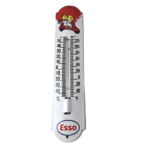
Vintage Esso Gasoline Sign – Gas Station Pump Ad Sign on Porcelain Thermometer
$140.37
A vintage Esso gasoline porcelain enamel advertising thermometer in the gas station pump display format — the rarest and most distinctly functional object in the petroliana collecting category. The advertising thermometer combined a working temperature instrument with a branded promotional panel, giving gas stations a permanent, weather-resistant display piece that motorists consulted every day. Advertising thermometers first appeared in American commerce in the 1890s and became widespread by the 1920s; the porcelain enamel version — kiln-fired vitreous glass on heavy-gauge steel, built to survive decades of outdoor weather — emerged as the premium format for high-traffic service station display in the 1930s through 1960s. The instrument itself descends from Daniel Gabriel Fahrenheit’s 1714 invention of the mercury-in-glass thermometer, the standardised temperature scale that still governs daily life in the United States. The Esso brand it advertises was formally launched by Standard Oil of New Jersey (Jersey Standard) in 1926 — the phonetic pronunciation of ‘S.O.’ and an acronym of Eastern States Standard Oil. Esso was the only major oil company to distribute the Negro Motorist Green Book (1936–1966) through its service station network; more than a third of all Esso franchise dealers were Black. Original kiln-fired vitreous enamel on heavy-gauge steel. Unrestored. Authenticated. Ships fully insured.
Vintage Esso Gasoline Porcelain Thermometer — Authentic Gas Station Pump Advertising Sign and Working Temperature Instrument
This is an authentic vintage Esso gasoline porcelain enamel advertising thermometer — a genuine kiln-fired piece in the gas station pump display format, combining a working mercury or spirit-filled glass temperature tube with a full-colour Esso branded panel. It is an original piece, circa 1930s–1960s, not a reproduction, a licensed reprint, or a modern tin-plate copy. Every colour — the Esso red, white, and blue oval logo, the branded typography, the decorative panel — is kiln-fired glass enamel fused to heavy-gauge steel at up to 900 degrees Fahrenheit, built to survive decades of outdoor weather at an active service station.
The advertising thermometer is the rarest and most distinctly functional object in the petroliana collecting category. Unlike a pump plate or a forecourt sign — which communicated a brand passively to passing motorists — the thermometer performed an active daily service for everyone who stopped to read it. Every person who checked the temperature also read the Esso name. That repeated functional engagement made the thermometer one of the most cost-effective advertising investments a service station could make — and one of the most visually memorable objects it displayed.
A porcelain enamel Esso thermometer is also one of the most weather-resistant objects in the entire history of commercial signage. The combination of kiln-fired glass surface and heavy steel substrate produced a piece that could hang outdoors for fifty years — through frost, rain, sun, and wind — and still display its temperature reading accurately and its Esso branding vividly. The surviving examples in collector hands today have, in many cases, done exactly that.
The Advertising Thermometer: From 1890s Newspapers to 1960s Service Stations
The advertising thermometer first appeared in American commerce in the 1890s. The earliest documented commercial advertisement for advertising thermometers appeared in The New York Sun on August 15, 1897, placed by Taylor Bros. Co. of Rochester, New York — ‘Where the good thermometers come from’ — announcing their line of advertising thermometer novelties for 1897–1898 and seeking salesmen at liberal commission. Taylor Instruments, founded by George Taylor in 1851, had factories not only in Rochester but in Toronto, London, New York City, Chicago, Baltimore, and Boston by the turn of the century — a manufacturing footprint that reflected the scale of demand for branded promotional instruments across American commerce.
The earliest advertising thermometers were made of tin and wood — functional but vulnerable to weather and short-lived as outdoor displays. By the 1910s and 1920s, as the automobile transformed American roadside culture and service stations multiplied across the country, demand emerged for a more durable outdoor format. The porcelain enamel advertising thermometer — kiln-fired glass on heavy steel, identical in construction to the pump plates and forecourt signs that oil companies were already using extensively — answered that demand. By the 1920s, as American towns and cities urbanised rapidly, outdoor advertising thermometers became a standard fixture of the commercial landscape: gas stations, general stores, pharmacies, bakeries, and hardware stores all mounted them where customers could see them daily.
The commercial logic was precise: a business that gave the public a useful, functional object — one that people consulted every morning to decide how to dress, every afternoon to gauge the weather, every day of the year — kept its name in front of those people continuously and free of charge after the initial cost of the sign. The Esso thermometer on the wall of a service station was not an advertisement that motorists could choose to ignore. It was the thermometer — the only one on the street, the one the whole neighbourhood used. Esso’s name came with it, every time.
Format peak: Porcelain enamel advertising thermometers reached their commercial peak between the 1930s and the 1960s — precisely the era when Esso’s service station network was at the height of its expansion, when motorists were most dependent on roadside service station facilities, and when the full-service attendant model gave the service station a daily community role that the self-service forecourt of the 1970s onward could not replicate.
Daniel Gabriel Fahrenheit, 1714, and the Scale on This Thermometer’s Tube
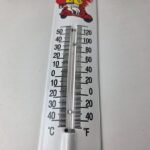
The temperature scale printed on the glass tube mounted in this Esso thermometer is the Fahrenheit scale — the system of temperature measurement invented by Daniel Gabriel Fahrenheit, a Polish-born Dutch physicist born in Gdańsk on May 24, 1686. Fahrenheit became fascinated with thermometers after encountering the Florentine thermometer — a glass tube with an alcohol-filled bulb, invented in Italy in the mid-seventeenth century — circulating in Amsterdam. The Florentine instrument had a fundamental flaw: with no standard calibration method, no two thermometers registered the same temperature, making scientific comparison between observers impossible.
Fahrenheit resolved this by developing a reliable mercury-in-glass instrument. After years of experimenting and travelling across Europe to study with instrument makers in Germany, Denmark, and England, he constructed his first successful alcohol thermometer in 1709. In 1714, working with glass-blowers in Berlin and Dresden, he produced the first mercury-in-glass thermometer — replacing alcohol with mercury, which expanded at a more constant rate across a wider temperature range and, crucially, did not wet the walls of the glass tube, enabling precise and repeatable readings. The key to his success was a method he developed for cleaning mercury so that it would not adhere to the glass — a technique he kept proprietary for years. One of the three known surviving original Fahrenheit thermometers sold at auction for more than £67,000 in 2012.
In 1724, Fahrenheit published his temperature scale in the Philosophical Transactions of the Royal Society — the journal of the scientific body that had elected him a Fellow that same year. He set his zero point at the temperature of a brine solution of ice, water, and ammonium chloride; 32°F as the freezing point of water; and 212°F as the boiling point — a range of 180 degrees, a number chosen for its mathematical divisibility. Human body temperature he initially calibrated at 96°F (later adjusted to 98.6°F). The Fahrenheit scale dominated the English-speaking world for more than two centuries, driven by its adoption in Britain and the spread of the British empire. It remains the primary temperature scale in daily use in the United States — the country on whose roadside service stations this thermometer hung.
The chain: Fahrenheit invented the mercury thermometer in 1714 and published his scale in 1724. Taylor Bros. Co. began manufacturing advertising thermometers with that scale in the 1890s. Porcelain enamel advertising thermometers became the standard service station format by the 1930s. Esso mounted them at its stations through the 1960s. The numbers on this thermometer’s tube are Fahrenheit’s numbers — three centuries of instrument history compressed into a gas station wall sign.
Ingram-Richardson and the Making of a Porcelain Thermometer
The porcelain enamel body of this thermometer was produced by one of the specialist manufacturers of kiln-fired advertising signs that dominated the American market from the turn of the century through the 1960s. The most significant of these was Ingram-Richardson Manufacturing Company — known universally as ‘Ing-Rich’ — of Beaver Falls, Pennsylvania. Founded in 1901 by Louis Ingram and Ernest Richardson, two English-born enamellers who had immigrated to Pennsylvania, Ing-Rich grew from a struggling predecessor company (the Enameled Iron Company of Beaver Falls) into the largest porcelain enamel sign manufacturer in the United States, employing over 1,000 people at its peak and operating additional plants in Frankfort, Indiana and Bayonne, New Jersey.
Ing-Rich produced signs for the full range of American commercial clients — oil companies including Mobil and Texaco, automotive manufacturers, breweries, food companies, and state governments — and was noted for the quality and detail of its multi-colour enamel work, with some signs using up to seven different enamel colours in a single piece. During World War II, Ing-Rich converted its production facilities to manufacture armour plating for U.S. military tanks. The company produced its first silk-screened porcelain sign in 1912, and in 1934 — through a collaboration between Ing-Rich, Charles Wolf of Indianapolis, and William Wenning of Ceramic Color and Chemical Co. of New Brighton, Pennsylvania — developed and patented the oil mixing process for ceramic enamel colours that became the industry standard for the next generation of sign production. The Ing-Rich patent was licensed to other enamel manufacturers. The company was sold in 1965 to Park Electrochemical Corporation and operations ceased in 1967.
The porcelain thermometer presented a specific manufacturing challenge that flat signs did not: the glass tube and its temperature-sensitive liquid had to be seated precisely in the enamel panel without damage during the kiln-firing process — which meant the thermometer tube was mounted after the enamel panel was fired and cooled, fitted into a pre-formed channel or bracket. The interaction between the heavy porcelain enamel panel and the delicate glass tube created the thermometer’s characteristic dual presence as both sign and instrument — and it is the survival of the glass tube intact, alongside the enamel panel, that makes an original unbroken porcelain advertising thermometer among the most sought-after formats in the collecting category.
Collector note: Porcelain enamel advertising thermometers with the original glass tube intact and functional are significantly rarer than those missing the tube, which was fragile and often broken during removal or storage. A surviving original tube — even if the liquid column is incomplete — is a key value indicator for serious collectors.
The Esso Brand, Standard Oil of New Jersey, and January 10, 1870
The Esso brand advertised on this thermometer traces directly to the most dominant corporation in American industrial history. On January 10, 1870, John D. Rockefeller incorporated the Standard Oil Company of Ohio in Cleveland — a company that within a decade controlled 90 to 95 percent of all U.S. oil refining. The U.S. Supreme Court dissolved Standard Oil on May 15, 1911 into 34 independent companies under the Sherman Antitrust Act. One of the 34 was Standard Oil Company of New Jersey (Jersey Standard), which trademarked the name ‘Esso’ — the phonetic pronunciation of ‘S.O.’ (Standard Oil’s initials), also an acronym of Eastern States Standard Oil — and formally launched it as a retail brand in 1926, building a network of dedicated service stations identifiable by their oval red and blue logo, branded canopies, and uniformed attendants.
From the late 1930s through 1966, Esso service stations were the only major oil company network to distribute the Negro Motorist Green Book — the essential travel guide for African American motorists navigating Jim Crow America, published annually from 1936 by Harlem postal worker Victor Hugo Green. The partnership was brokered by James A. Jackson, an African American marketing executive at Esso. More than a third of all Esso franchise dealers were themselves Black. Circulation grew from approximately 15,000 copies per year in the early years to over 2 million by 1962. Victor and Alma Green were inducted into the Automotive Hall of Fame in 2022.
In the United States, Esso was rebranded as Exxon in 1972 — driven by the need for a trademark usable in all 50 states, as a 1937 federal court injunction had blocked Esso in states where other Standard Oil successor companies held territory. The removal of Esso branding from U.S. service stations during the 1972 rebrand, combined with the broader obsolescence of porcelain enamel in commercial signage by the early 1970s, means that surviving original Esso porcelain pieces in good condition are genuinely scarce. In the thermometer format — the most fragile of all Esso porcelain formats — that scarcity is compounded by the vulnerability of the glass tube.
Thermometer as Advertising Medium: Why This Format Outlasted Every Other
The advertising thermometer outlasted every other format of static commercial signage in one specific quality: it could not be ignored. A motorist might drive past a pump plate without reading it. A passerby might not notice a forecourt sign. But the thermometer was consulted — actively, deliberately, every day — by every person in the neighbourhood who needed to know whether to bring a coat, whether their pipes might freeze, whether the weekend would hold for the drive they had planned. The brand on the thermometer was not an intrusion. It was associated, in the user’s mind, with the reliable information the thermometer provided. That associative benefit was understood by advertisers from the 1890s onward as something no flat sign could replicate.
The service station setting amplified this effect. A gas station served the same motorists repeatedly — the same routes, the same fill-up stops, the same community. The Esso thermometer on the station wall was as familiar to regular customers as the pump attendant. It was part of the landscape of a relationship, not an anonymous advertisement. In the years before smartphones put a weather app in every pocket, the roadside thermometer was an infrastructure — a piece of public utility that happened to carry a brand name. The Esso name on this thermometer was seen by every person who used it, on every day they used it, for as many decades as it hung on that wall.
Why porcelain specifically: Tin and wood advertising thermometers degraded rapidly outdoors — rust, warping, fading. The porcelain enamel version was built to last as long as the station itself. A kiln-fired Esso thermometer mounted in the 1940s was still readable, still accurate, and still displaying its brand clearly in the 1960s and 1970s — a thirty-year advertising impression at zero recurring cost to the station owner.
About This Piece: Format, Construction & Condition
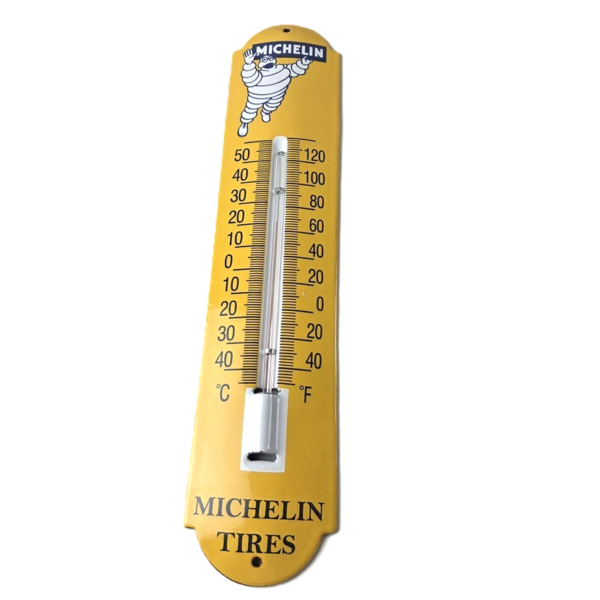
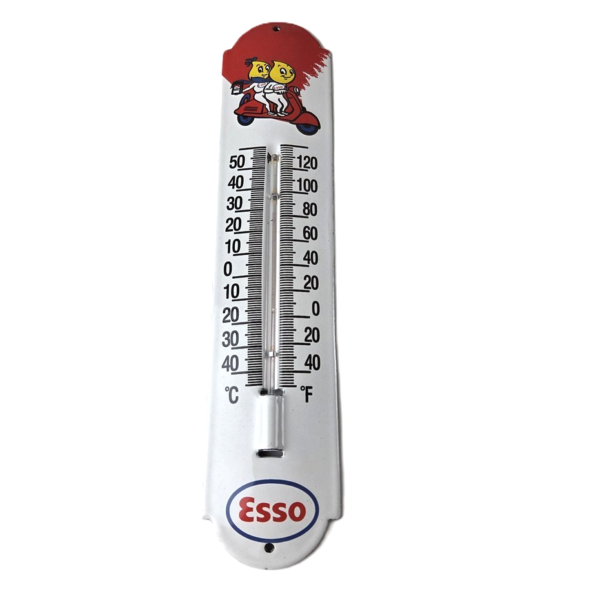
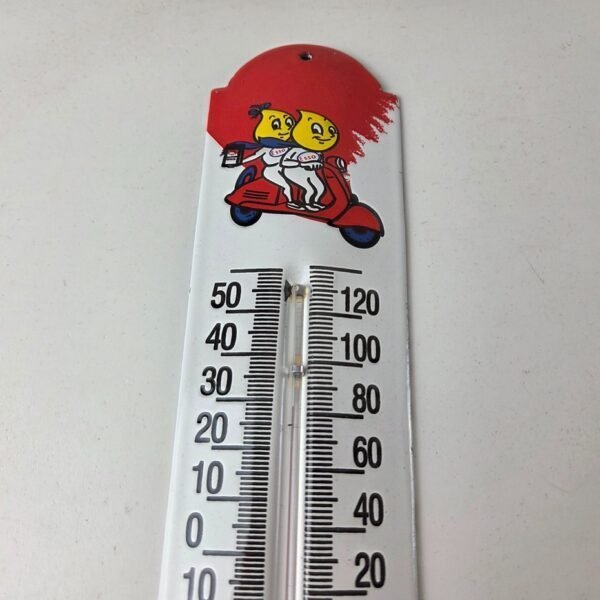
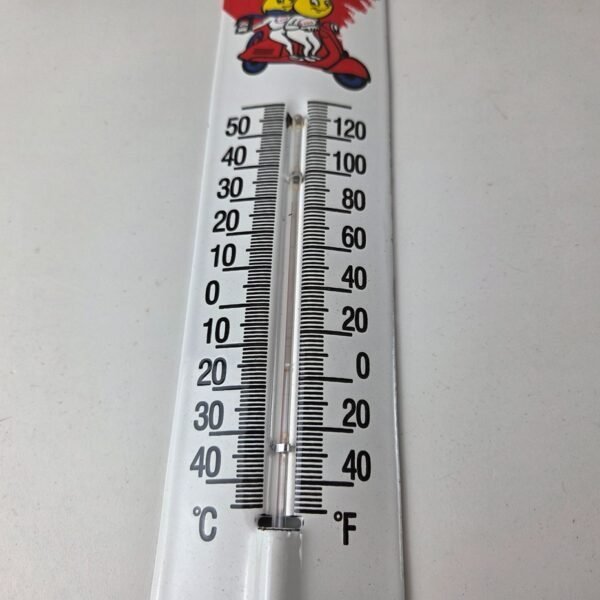
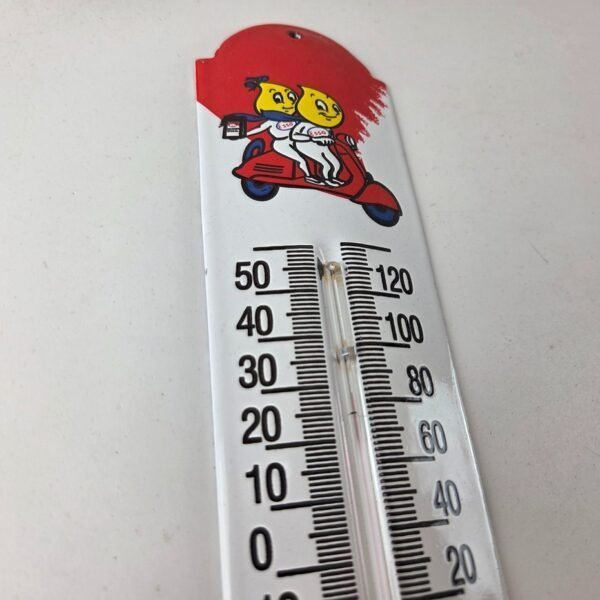
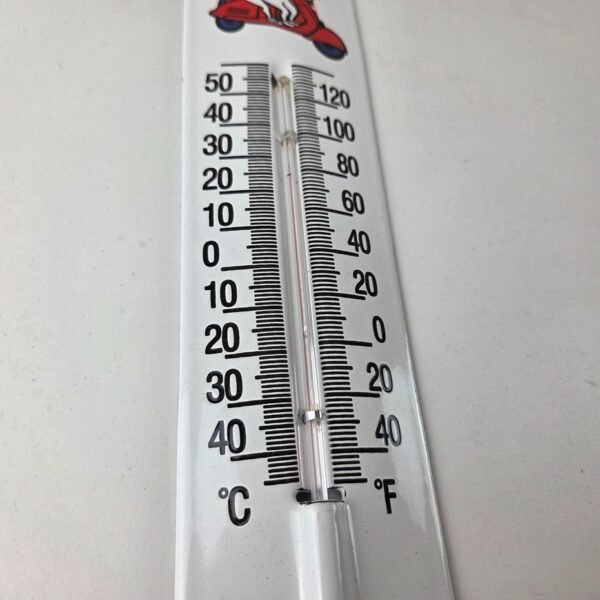
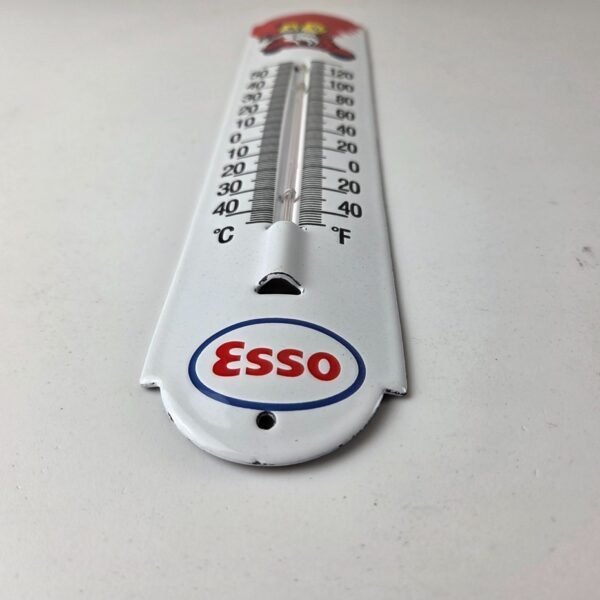
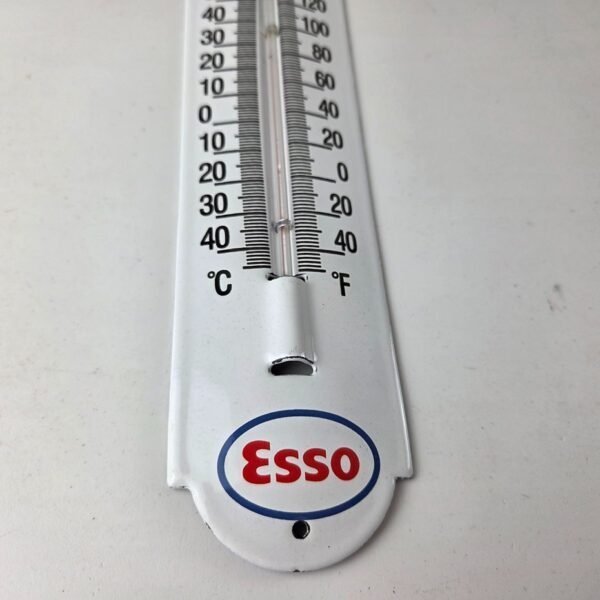
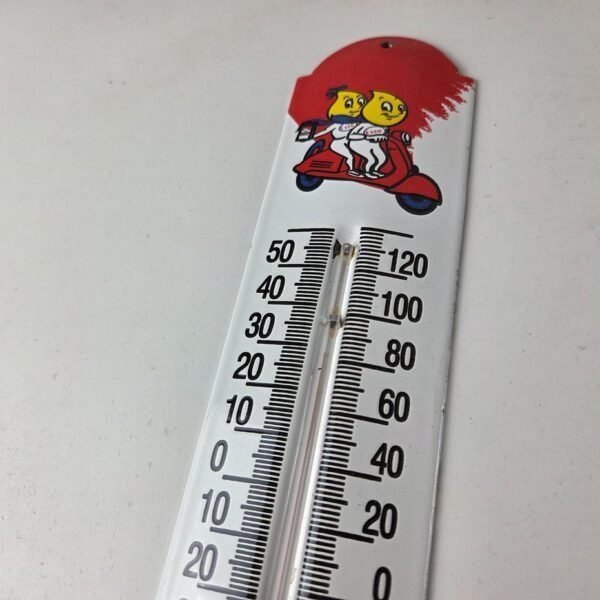
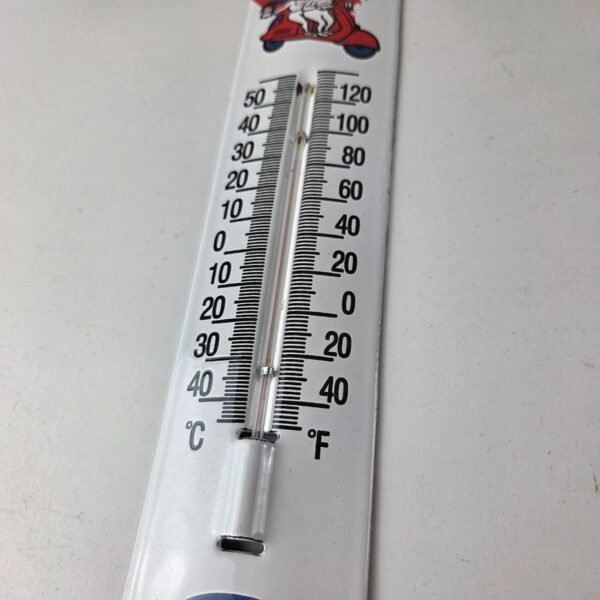
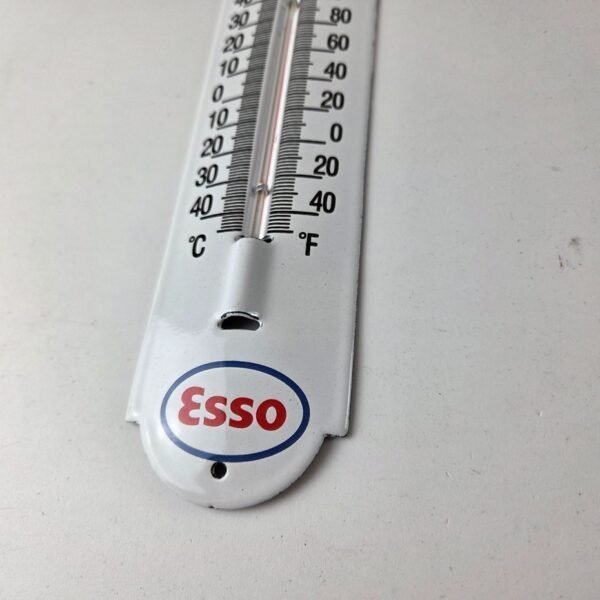
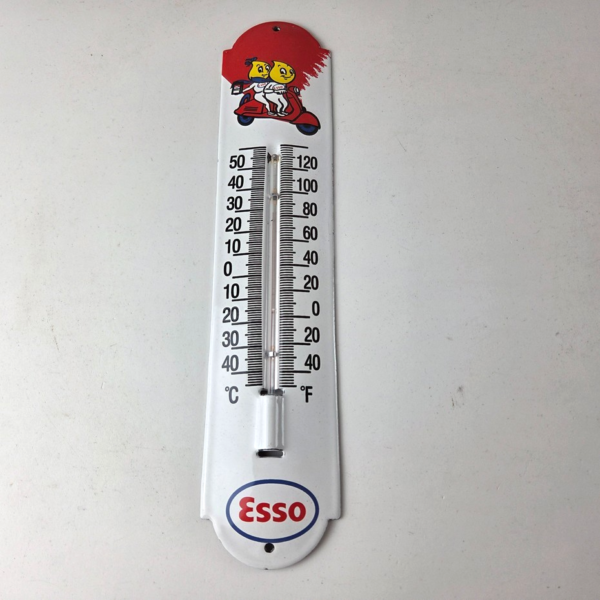
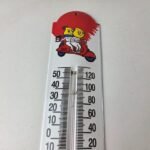
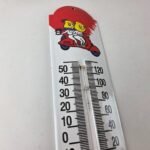
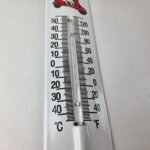
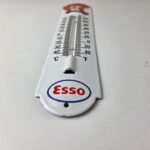
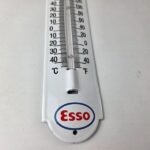
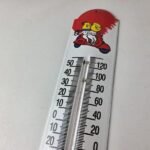
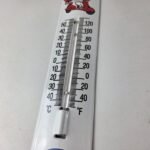
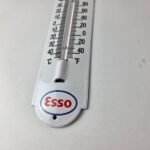
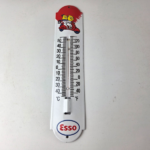
This thermometer is in the vertical rectangular gas station display format — the standard form for porcelain enamel advertising thermometers produced for outdoor service station use. The Esso oval logo in red and blue on white occupies the upper panel; the temperature scale and glass tube run centrally; additional Esso branding and product information fill the lower panel. The kiln-fired glass enamel retains the vivid depth and surface gloss of original period production — not the flat presentation of a reproduction. Heavy-gauge steel substrate, edge enamel wrap, and mounting wear confirm period-correct manufacture.
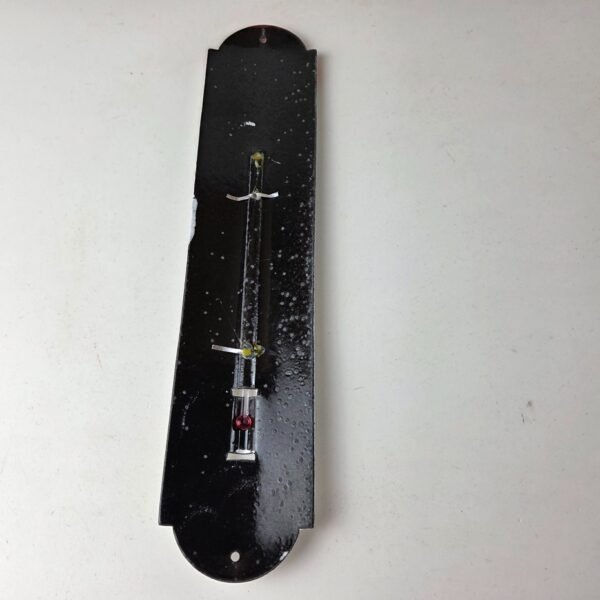
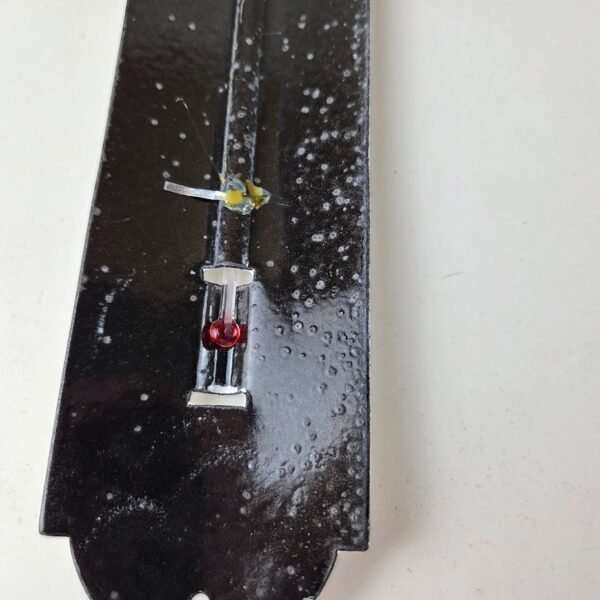
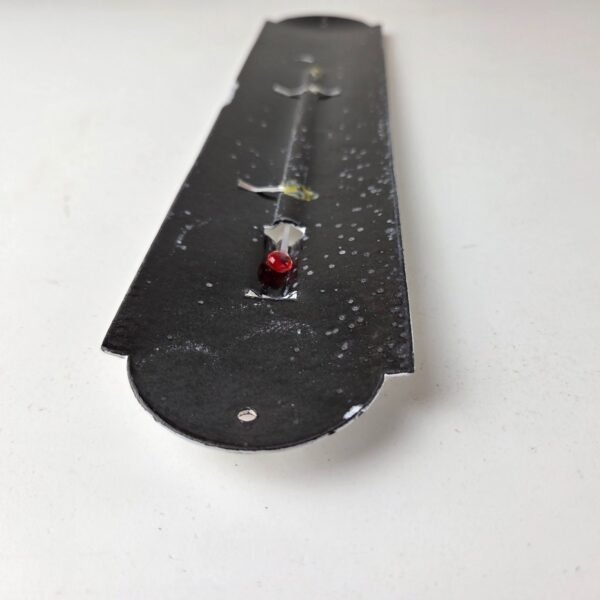
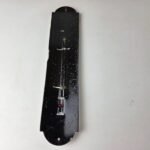
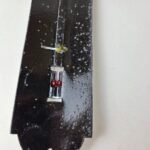
Condition note: This piece is presented in original, unrestored condition. Any wear, chipping, or surface character on the enamel reflects natural aging from outdoor commercial display. The condition of the glass tube — whether intact, partial, or absent — is noted in the product listing. An original Esso porcelain thermometer with its glass tube present and the enamel panel in strong condition is among the most desirable single-piece petroliana items in collector circulation.
Product Specifications
| Specification | Detail |
| Product type | Vintage porcelain enamel advertising thermometer (original, not a reproduction) |
| Brand | Esso (Standard Oil of New Jersey / Jersey Standard) |
| Thermometer origin | Fahrenheit mercury-in-glass thermometer invented 1714; Fahrenheit scale published 1724 |
| Ad thermometer era | Advertising thermometers in commerce from 1890s; porcelain enamel format peak 1930s–1960s |
| Maker | Likely Ingram-Richardson (Ing-Rich), Beaver Falls, PA (est. 1901) or Baltimore Enamel & Novelty — leading U.S. porcelain sign manufacturers of the era |
| Esso brand | Launched 1926 by Jersey Standard; phonetic for ‘S.O.’ (Standard Oil); acronym of Eastern States Standard Oil |
| Standard Oil | Founded January 10, 1870 by Rockefeller; dissolved by Supreme Court May 15, 1911 into 34 companies |
| Green Book | Only major oil company to distribute the Negro Motorist Green Book (1936–1966); over one-third of Esso dealers were Black |
| Exxon rebrand | Esso rebranded Exxon in United States May 1972; Esso retained internationally |
| Sign format | Vertical rectangular outdoor gas station advertising thermometer |
| Sign era | Circa 1930s–1960s — full-service attendant era |
| Construction | Kiln-fired vitreous enamel on heavy-gauge steel, 18–22 gauge; glass thermometer tube |
| Condition | Original, unrestored — see condition note above |
| Authentication | Authenticated by Vintage Porcelain Signs Store |
Why This Piece Is Collected: Three Overlapping Collector Audiences
The Esso porcelain advertising thermometer draws from three distinct collecting categories that converge on a single object:
1. Petroliana Collectors — Thermometer Format Specialists
Within petroliana collecting, the advertising thermometer is a distinct sub-category with its own specialist collectors — separate from, and often overlapping with, collectors of flat pump plates, forecourt signs, and oil can displays. The Esso oval is one of the three or four most actively collected brand identities in American petroliana. In the thermometer format, original Esso porcelain pieces are among the most sought-after brand representations — combining the brand’s strong collector appeal with the thermometer format’s inherent scarcity, its functional history, and its three-dimensional presence on a wall or display surface.
2. Advertising Thermometer Collectors
Advertising thermometer collecting is a self-contained category with its own reference literature, price guides, and specialist collectors who focus on thermometers across multiple brands, industries, and formats — from Coca-Cola and tobacco company thermometers to oil and gas, hardware, and food brands. Within this category, porcelain enamel oil company thermometers from the 1930s–1960s represent the premium tier: the most durable construction, the most visually striking format, and the most closely associated with the mid-century American roadside commercial landscape. Esso is among the top three or four most collected oil company brands in this category.
3. American History and Civil Rights Collectors
As with the Esso pump sign format, an original Esso thermometer carries the brand’s documented role as the primary institutional distribution partner of the Negro Motorist Green Book — the annual guide to safe travel for African American motorists in the Jim Crow era. The Esso service station that displayed this thermometer was the same station that sold Victor Green’s guide to Black motorists navigating an America where most hotels, restaurants, and roadside facilities were closed to them. No other oil company thermometer carries this dimension.
Additional Buyer Audiences
- Scientific instrument and measurement history collectors: The Fahrenheit thermometer connection — from Daniel Gabriel Fahrenheit’s 1714 mercury instrument to the calibrated glass tube in this service station sign — places the Esso thermometer in a 300-year chain of instrument history. Collectors focused on the history of measurement and scientific instruments regard original advertising thermometers as the consumer endpoint of that chain.
- Man cave, garage, and vintage décor buyers: The advertising thermometer is a practical display piece as well as a collecting item — it is, in many cases, still functional. An original Esso porcelain thermometer on a garage or workshop wall is both an authentic petroliana piece and a working temperature gauge.
- Roadside Americana collectors: The thermometer as a community utility object — the one that the whole neighbourhood checked — is the most deeply embedded of all service station objects in mid-century American local life. It belongs naturally alongside travel signs, diner signs, and gas station pump plates in a roadside Americana collection.
Market context: Original porcelain enamel advertising thermometers with the glass tube intact are among the most consistently priced and most actively sought formats in petroliana and general advertising collecting. The combination of functional history, fragile glass tube survival, brand identity, and outdoor construction makes them rarer survivors than flat signs — and the Esso brand identity, with its documented civil rights history and post-1972 rebrand removal, adds a historical dimension that sustains collector demand independent of general petroliana market cycles.
Authenticity & Display
Authentication
This piece passes all standard porcelain enamel authentication checks — substrate weight (heavy-gauge steel), continuous edge enamel wrap, mounting hole wear consistent with decades of outdoor commercial display, and the deep glassy sheen of kiln-fired enamel rather than a screen-printed reproduction. The glass tube condition is assessed and noted in the individual product listing. For full authentication methodology see our Porcelain Sign Authentication Guide. For petroliana thermometer collecting guidance see our Collector Resources page.
Where This Piece Displays Best
- Service station and garage themed collections: An original Esso porcelain thermometer mounted in a period garage setting is not décor but a document — a piece that hung at an active service station for decades, reading the temperature for every motorist and local who consulted it.
- Man caves and home workshops: Still functional in many cases — the original Esso thermometer on a workshop wall is the authentic version of what reproduction tin thermometers attempt to evoke, and it actually reads the temperature.
- Roadside Americana and petroliana collections: Pairs naturally alongside Esso pump signs, motor oil signs, travel signs, and service station ephemera — the full mid-century roadside commercial ecosystem.
- American history displays: Given Esso’s role in the Green Book distribution network, an original Esso thermometer belongs equally in any display focused on civil rights-era road culture, African American travel history, or mid-century American community life.
Explore Related Collections
More porcelain thermometers · Gas & motor oil signs · Motor oil signs · Automobile signs · Travel signs · Authentication Guide · Collector Resources · Full shop