











Vintage Chevron Gasoline Sign – Airplane Cartoon Aviation Gas Ad Porcelain Sign
$135.37
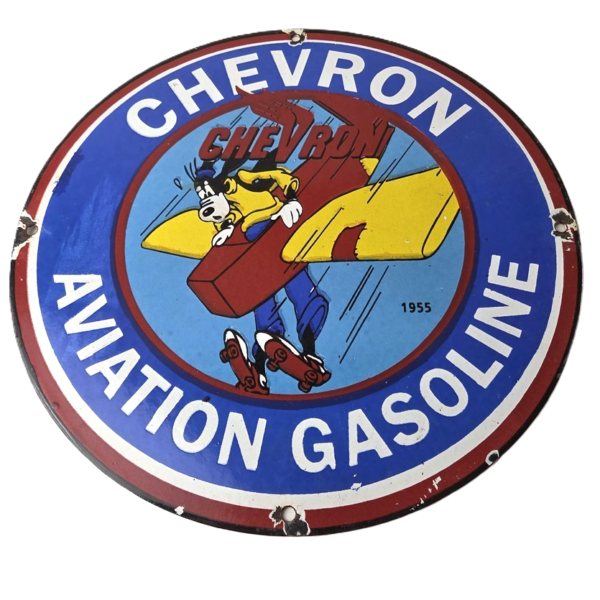
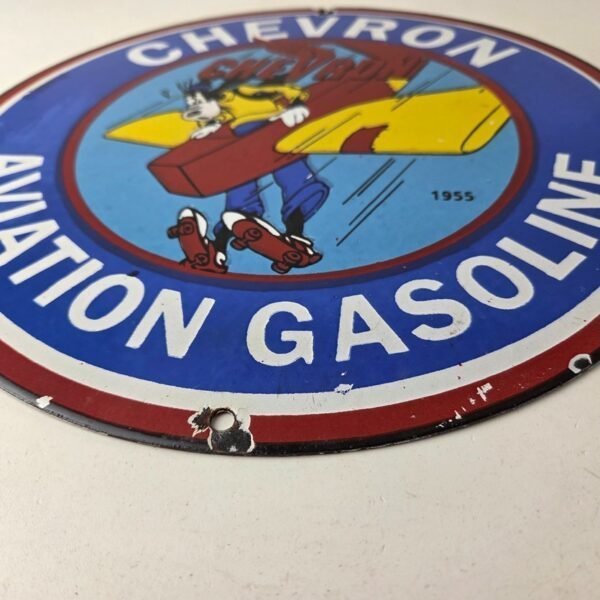
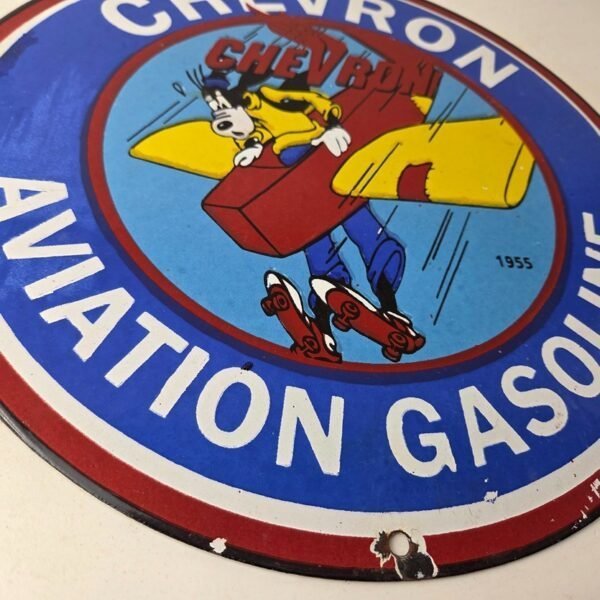
A vintage Chevron aviation gasoline porcelain enamel sign featuring a cartoon airplane motif — an authentic kiln-fired advertising piece from the era when Standard Oil of California marketed specialised aviation fuel directly to civilian pilots and flying clubs alongside its standard automotive range. Chevron’s oldest predecessor, Pacific Coast Oil Company, was incorporated in San Francisco on September 10, 1879; Standard Oil of California (Socal) was formed from its assets in 1906. The Chevron brand name was introduced for retail fuel in the 1930s. Charles Lindbergh used Socal’s Red Crown Aviation Gasoline in the Spirit of St. Louis for his solo transatlantic flight of May 20–21, 1927. Standard Oil of California subsequently produced more than one billion gallons of 100-octane aviation fuel for the Allied forces during World War II — a contribution General Henry ‘Hap’ Arnold credited as decisive to Allied air superiority. In the postwar years, Chevron marketed its high-performance aviation blend under the ‘Skypower’ name for both aircraft and high-compression automotive engines. Original kiln-fired vitreous enamel on heavy-gauge steel. Unrestored. Authenticated. Ships fully insured.
Vintage Chevron Aviation Gasoline Porcelain Sign — Cartoon Airplane Advertising Enamel Piece from the Golden Age of American Flight
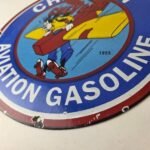
This is an authentic vintage Chevron aviation gasoline porcelain enamel sign featuring a cartoon airplane motif — a genuine kiln-fired advertising piece from the era when Standard Oil of California marketed specialised aviation fuel at service stations and small general aviation airfields. It is an original piece, circa 1940s–1960s — not a reproduction, a printed sign, or a modern tin-plate copy. Every colour is kiln-fired glass fused to heavy-gauge steel at up to 900 degrees Fahrenheit, preserving the Chevron red and blue chevron badge and the cartoon airplane illustration with the saturation and surface depth that no printed sign can replicate.
The cartoon airplane format places this sign at the intersection of two of the most actively collected categories in American petroliana: Chevron/Standard Oil of California signs, and aviation advertising. Original enamel signs combining a major oil brand identity with aviation imagery are among the rarest and most narrative pieces in both collecting categories — they document the specific period when commercial aviation was transitioning from a specialist activity to an everyday American aspiration.
Every airport, grass airstrip, and flying club in 1950s America had a fuel pump. The companies that supplied avgas advertised at the pump exactly as they did at automobile service stations — with porcelain enamel signs. A cartoon airplane on a Chevron pump sign was not whimsy: it was the visual shorthand that told a pilot on approach that this airfield sold high-quality aviation-grade fuel from a brand he could trust.
Pacific Coast Oil, Standard Oil of California, and the Chevron Brand: 1879 to the 1930s
Chevron’s oldest direct predecessor, Pacific Coast Oil Company, was incorporated in San Francisco on September 10, 1879, by Frederick Taylor, Charles Felton, and a group of California investors. Taylor had been prospecting in the rugged canyons north of Los Angeles, and his Pico Well No. 4 — struck in September 1876 in Pico Canyon — was the most productive oil well in California. Pacific Coast built the state’s first modern refinery at Alameda Point on San Francisco Bay and launched California’s first steel-hulled tanker, the George Loomis, in 1895, capable of transporting 6,500 barrels of crude.
In 1900, Standard Oil of Iowa — a West Coast marketing subsidiary of Rockefeller’s Standard Oil Trust — acquired Pacific Coast Oil, and in 1906, Jersey Standard consolidated both entities into a single new company: Standard Oil Company of California, known universally as Socal. When the U.S. Supreme Court dissolved the Standard Oil Trust in May 1911 into 34 independent companies, Socal emerged as the largest oil company on the Pacific Coast and the leading gasoline retailer in the western states. It held exclusive rights to the ‘Standard’ name in California and the western states — a trademark that Chevron maintains to this day by operating one Standard-branded Chevron station in each of its 16 western states, preserving the mark under the use-it-or-lose-it rule of American trademark law.
In 1907, Socal opened what is documented as the world’s first purpose-built service station in Seattle, Washington — a dedicated facility with a curbside gasoline dispenser, products displayed on shelves, and uniformed attendants, establishing the service station format that would define the entire 20th century petroliana landscape. Through the 1910s and 1920s, the company expanded its retail footprint aggressively across the Pacific states, launching product lines under multiple brand names. The Chevron name was introduced as a retail fuel brand in the 1930s — derived from the heraldic chevron, the downward-pointing V-shape that had appeared in various forms in Socal’s visual identity since the earliest decades. By the 1940s ‘Chevron’ had become the dominant consumer-facing brand, with dedicated Chevron service stations, pump canopies, and enamel signage appearing across the western states.
Charles Lindbergh, Red Crown Aviation Gasoline, and May 20–21, 1927
On May 20–21, 1927, Charles A. Lindbergh completed the first solo nonstop transatlantic flight in the Ryan NYP monoplane Spirit of St. Louis — 3,600 miles from Roosevelt Field, Long Island to Le Bourget aerodrome outside Paris in 33.5 hours. The flight made Lindbergh the most celebrated man in the world overnight. When asked what fuel he had used, Lindbergh was specific: Standard Oil of California’s Red Crown Aviation Gasoline. He said he had chosen it because he found he could achieve greater range per gallon than with other available fuels — a statement of direct performance endorsement that Socal’s advertising department used immediately and extensively.
Promotional portrait photographs were produced showing Lindbergh posed alongside the Spirit of St. Louis with Red Crown Aviation Gasoline branding prominently displayed. The Lindbergh endorsement positioned Socal’s aviation fuel as the product of record for the most important flight in aviation history — and established the Red Crown brand as the benchmark for aviation gasoline quality on the U.S. West Coast through the 1930s and into the war years. It was a marketing association that competitors in the petroliana market could not match: no other oil company could claim that its fuel had carried a man alone across the Atlantic Ocean.
Collector context: The Lindbergh/Red Crown Aviation Gasoline connection is the single most powerful aviation provenance fact in American oil history. No other petroliana brand — Shell, Esso, Gulf, Texaco — can claim a direct, documented, first-person performance endorsement from the pilot of the defining flight of the 20th century. An original Chevron or Standard Oil of California aviation sign is an artefact from a brand whose history intersects with that moment.
One Billion Gallons: Standard Oil of California and World War II Aviation Fuel
When the United States entered World War II in December 1941, the Allied air forces faced an urgent and singular technological challenge: their aircraft needed 100-octane aviation gasoline — a fuel that had only been available in limited quantities before the war and had to be produced at industrial scale, immediately, from refineries capable of the complex catalytic cracking process the fuel required. The difference between 100-octane avgas and the 87-octane automotive fuel standard was not incremental — it was decisive. British Spitfires running on American 100-octane fuel were up to 34 miles per hour faster at 10,000 feet than they had been on 87-octane, with climb rates increased by 500 to 1,000 feet per minute. In the Battle of Britain in 1940, this fuel advantage — supplied by American refineries to Britain before U.S. entry into the war — was credited with turning the tide of the Luftwaffe’s campaign.
Standard Oil of California responded to the wartime demand with the full capacity of its Richmond and El Segundo refineries — two of the most technically advanced refining facilities in the United States. By the end of the war, Socal had produced more than one billion gallons of 100-octane aviation fuel for the Allied forces — a figure confirmed by Chevron’s own published corporate history. The production required a complete transformation of refinery operations: the shift from thermal to catalytic cracking, the manufacture of tetraethyl lead additive, the production of toluene (a key ingredient in TNT), and the deployment of over 4,000 women at the Richmond refinery alone by 1944, filling roles vacated when 25 percent of Socal’s male workforce went to serve in the armed forces.
The 100-octane advantage: Allied production of 100-octane avgas increased from 40,000 barrels per day in 1940 to 514,000 barrels per day by 1945 — a thirteen-fold increase achieved while simultaneously supplying all other wartime fuel needs. Military historians have consistently identified this fuel production achievement as one of the decisive logistical advantages of the Allied victory in the air war. General Henry ‘Hap’ Arnold, commanding the U.S. Army Air Forces, stated that air superiority in World War II was built as much in the refinery as in the factory.
Postwar Aviation: Chevron Aviation Gasoline, ‘Skypower,’ and the Civilian Flying Boom
The end of World War II triggered an extraordinary civilian aviation boom. Hundreds of thousands of trained military pilots returned to civilian life. Surplus Piper Cubs, Cessnas, Aeroncas, and military trainers flooded the market at prices ordinary working Americans could afford. The number of small general aviation airports, grass strips, and flying clubs across the United States multiplied rapidly through the late 1940s and into the 1950s. By 1950, there were approximately 6,000 general aviation airports in the United States — more than four times the number in 1940 — and nearly 400,000 private pilots holding certificates.
Standard Oil of California — marketing its aviation products under the Chevron brand from the 1930s onward — expanded its aviation fuel retail network directly into this booming market. The company had developed Chevron Aviation Gasoline as a distinct product line for aircraft, and introduced the Chevron Supreme ‘Skypower’ blend for both aircraft engines and high-compression automobile engines in the postwar years — marketing the wartime technology of high-octane refining as a civilian performance benefit. Point-of-sale advertising for Chevron’s aviation products at service stations and small airfields took the form of enamel pump signs featuring cartoon airplane illustrations — the format of this sign — mounted at the fuel pump or at the entrance to the airfield fuelling area to identify Chevron’s aviation-grade product to arriving pilots.
The cartoon airplane on a Chevron sign was not a decorative choice — it was a functional identifier in an era when pilots stopping for fuel at an unfamiliar airfield needed to confirm at a glance that the fuel available was aviation-grade, not the standard automotive gasoline that could damage an aircraft engine. The cheerful, streamlined cartoon plane was legible from a taxiing aircraft and immediately communicated ‘avgas sold here.’
Sign format context: Chevron aviation gasoline porcelain signs in the cartoon airplane format were produced primarily in the 1940s through 1960s and were displayed at service stations and general aviation airports that carried Chevron’s aviation product line. Their geographic distribution was broadly limited to the western United States, where Chevron held service station territory — giving surviving examples a specific regional character that is part of their collecting appeal.
The World’s First Service Station and the Chevron Sign Heritage
The service station sign format that produced this piece traces back to a specific year and a specific city. In 1907, Standard Oil of California opened what is documented as the world’s first purpose-built drive-in service station in Seattle, Washington — transforming petrol retail from a process of stopping at a hardware store or pharmacy to fill a can, to a dedicated facility where an automobile driver could pull in, be served by an attendant, and continue without leaving the car. The service station format that the 1907 Seattle station pioneered became the universal model for fuel retail worldwide.
The porcelain enamel sign — mounted at the station entrance, on the pump canopy, or at the pump face itself — was the primary medium through which that service station communicated its brand, its product range, and its prices to passing motorists. When Chevron extended its retail network to general aviation, the same format followed: kiln-fired enamel signs at the airfield pump, identifying the brand and the product, exactly as they identified automotive gasoline at the roadside station. The cartoon airplane sign is the direct aviation descendant of the service station pump plate — the same format, the same construction, the same function, applied to a different vehicle and a different grade of fuel.
About This Sign: Format, Construction & Condition
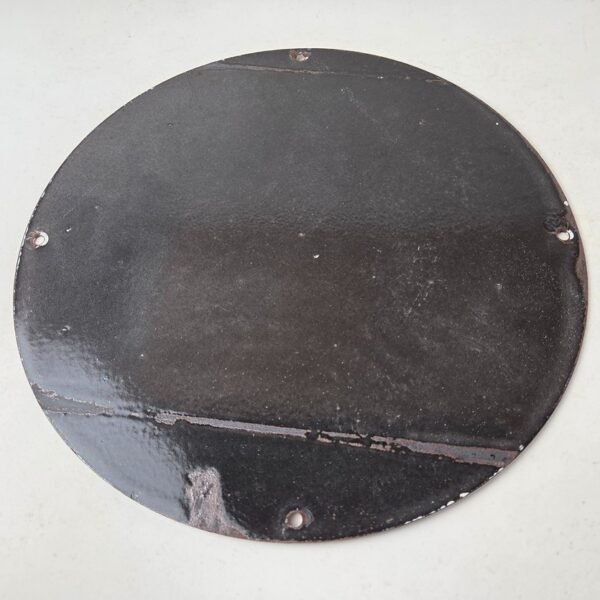
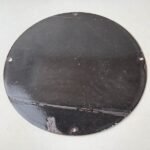
This sign is in the aviation gasoline pump display and airfield advertising format — the enamel panel produced for mounting at Chevron-supplied general aviation fuelling points and service stations carrying the aviation product line. The cartoon airplane illustration uses the vivid Chevron red-and-blue palette against a white field characteristic of Socal’s mid-century enamel sign production. The kiln-fired glass enamel retains the deep surface gloss and colour saturation of original period production — not the flat, uniform presentation of a reproduction. Heavy-gauge steel substrate, edge enamel wrap, and mounting wear confirm period-correct manufacture.
Condition note: This sign is presented in original, unrestored condition. Any wear, chipping, or surface character reflects natural aging from decades of commercial display use. Original unrestored condition is the preferred standard among serious petroliana and aviation sign collectors — an authentic piece with honest wear carries more authority than a cosmetically restored example.
Product Specifications
| Specification | Detail |
| Product type | Vintage porcelain enamel sign (original, not a reproduction) |
| Brand | Chevron (Standard Oil of California / Socal) |
| Parent company | Pacific Coast Oil Company, incorporated September 10, 1879, San Francisco |
| Standard Oil | Standard Oil of California formed 1906; independent from Standard Oil Trust dissolution May 1911 |
| World first | World’s first purpose-built service station opened 1907, Seattle, WA — Socal / Standard Oil of California |
| Chevron brand | Chevron name introduced as retail fuel brand in the 1930s; derived from heraldic chevron V-shape in company visual identity |
| Lindbergh | Socal’s Red Crown Aviation Gasoline used in Spirit of St. Louis for first solo transatlantic flight, May 20-21, 1927 |
| WWII production | Socal produced more than 1 billion gallons of 100-octane aviation fuel for Allied forces in World War II |
| Skypower | Postwar Chevron aviation blend marketed as ‘Skypower’ for aircraft and high-compression automotive engines, 1950s-1960s |
| Sign format | Aviation gasoline pump display and airfield advertising — cartoon airplane motif |
| Sign era | Circa 1940s–1960s — civilian aviation boom era |
| Construction | Kiln-fired vitreous enamel on heavy-gauge steel, 18–22 gauge |
| Condition | Original, unrestored — see condition note above |
| Authentication | Authenticated by Vintage Porcelain Signs Store |
Why This Sign Is Collected: Three Overlapping Collector Audiences
This sign draws from three distinct collector markets that intersect at a specific point of cultural and commercial history:
1. Petroliana Collectors — Chevron / Standard Oil of California
Chevron and Standard Oil of California are among the four or five most actively collected brands in American petroliana. Original Socal and Chevron enamel signs are geographically restricted to the western United States — unlike Shell or Texaco, which operated nationwide — giving surviving pieces a specific regional character and scarcity value. The Chevron brand’s visual identity (the distinctive red-and-blue chevron badge, the clean mid-century typography, the rich Socal corporate history) is immediately recognisable to petroliana collectors, and original enamel signs in good condition command consistent prices at specialist auctions and dealer sales.
2. Aviation Collectors and Flying History Enthusiasts
A porcelain enamel sign advertising aviation gasoline with a cartoon airplane illustration is the physical artefact of the civilian flying boom era — when hundreds of thousands of returning WWII veterans took to the air in surplus trainers and light aircraft, when 6,000 general aviation airports dotted the American landscape, and when oil companies competed for the avgas market with dedicated product lines and airfield point-of-sale advertising. Aviation history collectors who focus on the period from Lindbergh through the Space Age identify original avgas signs as key pieces in the material culture of American flight — particularly signs from brands with documented aviation history as strong as Chevron’s.
3. Roadside Americana and California History Collectors
Standard Oil of California and the Chevron brand are inseparable from the history of the American West Coast. Socal opened the world’s first service station in Seattle in 1907. Its predecessor, Pacific Coast Oil, drilled at Pico Canyon in 1876, beginning the California oil industry. Lindbergh chose its fuel for the flight that defined the age of aviation. Its Richmond refinery produced a billion gallons of 100-octane fuel that helped win the Second World War. A Chevron aviation sign is not only a petroliana piece — it is a document of California, the West Coast, and American technological ambition from the gold rush era to the jet age.
Additional Buyer Audiences
- Man cave, garage, and vintage aviation décor buyers:The combination of a major oil brand identity and a cartoon airplane motif on original kiln-fired enamel produces one of the most visually distinctive display pieces in either the petroliana or aviation collecting categories. No reproduction captures the surface quality of original enamel.
- Mid-century Americana collectors:The cartoon airplane aesthetic on commercial petroliana signs is a specific and dateable art form — streamlined, optimistic, mid-century American in exactly the way that the Atomic Age and the Space Age created a visual vocabulary for civilian flight. A Chevron avgas sign is a direct product of that aesthetic moment.
- WWII and military history collectors:Given Socal’s documented production of over one billion gallons of 100-octane aviation fuel during World War II, a Chevron aviation sign connects directly to the industrial story of Allied air superiority — the billion-gallon number that military historians regard as one of the decisive logistical contributions to the Allied victory.
Market context: Original porcelain enamel aviation gasoline signs from major oil brands are among the scarcer formats in petroliana collecting — produced in smaller quantities than automotive gasoline signs and mounted at airfields rather than the far more numerous roadside service stations, they were lost, discarded, or damaged at a higher rate. A Chevron aviation sign in good condition, with the cartoon airplane motif intact, is a genuinely uncommon piece.
Authenticity & Display
Authentication
This sign passes all standard porcelain enamel authentication checks — substrate weight (heavy-gauge steel), continuous edge enamel wrap, mounting hole wear consistent with decades of commercial display, and the deep glassy surface sheen of kiln-fired enamel rather than the flat surface of a screen-printed reproduction. For full authentication methodology see our Porcelain Sign Authentication Guide. For petroliana and aviation collecting guidance see our Collector Resources page.
Where This Sign Displays Best
- Vintage garages and automotive collections with western or California themes:Chevron and Standard Oil of California are the West Coast’s defining petroliana brands. An original Chevron enamel sign carries the specific regional authority that sets it apart from nationally distributed brands.
- Aviation-themed rooms, hangars, and flying clubs:An original avgas pump sign from a brand whose fuel carried Lindbergh across the Atlantic is a legitimate piece of aviation history — not merchandise.
- Man caves and home bars with aviation or automotive themes:The cartoon airplane format is one of the most visually engaging in the entire enamel sign collecting category — bright, legible, narrative, and period-specific.
- Roadside Americana and petroliana collections:Pairs naturally alongside motor oil signs, gas pump plates, automobile signs, and travel signs — the full mid-century roadside commercial ecosystem.
Explore Related Collections
More gas & motor oil signs · Motor oil signs · Aviation signs · Automobile signs · Travel signs · Authentication Guide · Collector Resources · Full shop


Related products


Vintage Goodyear Blimp Sign – Porcelain Gas Service Tires Advertising Sign